
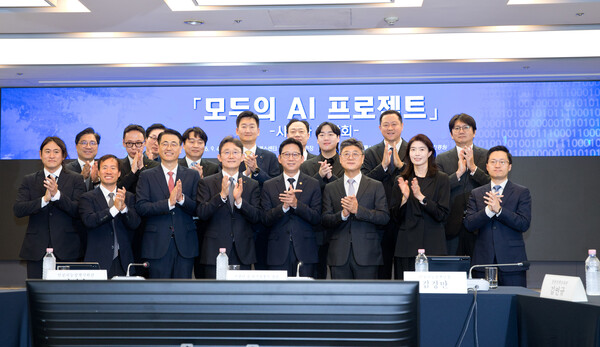
The 'Everyone's AI' project, aimed at helping all citizens easily use AI services in daily life, has taken its first step. Three consortia led by SK Telecom, KT and Kakao will roll out beta services in stages as early as late this month and move to launch services for the public within the year. The government plans to spend 250 billion won next year to speed up the rollout of the services.
The Ministry of Science and ICT held a launch meeting for the 'Everyone's AI' project on Thursday at the Korea Press Center in Seoul and unveiled service development plans by the SK Telecom, Kakao and KT consortia, along with future support measures.
Everyone's AI is a nationwide AI service programme jointly 추진 by the government and private sector so anyone can use AI easily and conveniently. The goal is to build AI agent services that handle real tasks, from information searches to applications, reservations and payments, beyond simple chatbots.
Bae Kyung-hoon (배경훈), deputy prime minister and science minister, called for differentiation from existing AI services. "If there is not much difference from existing services when it is first launched, the public will be disappointed," Bae said. "Please bring together your efforts so we can launch services that will surprise the public," he said.
The government will also use Everyone's AI as a testbed to link a proprietary AI foundation model, domestically made neural processing units (NPUs), agentic AI and data technology to real services. "Another goal is to open up opportunities for domestic NPUs to be used and to blend agentic optimisation technology, data processing technology and foundational technology to jump-start South Korea's basic capabilities," Bae stressed.
BETA SERVICE NEARS, FOCUS ON 'EXECUTION, ACCESS AND CONNECTION'
The three consortia will roll out beta services in stages from late this month and no later than mid-next month. Each aims for services that carry out users' real actions, while seeking differentiation by incorporating the strengths of participating companies.
SKT is focusing on "execution-type AI" that carries out procedures from authentication to applications and payments. It will also introduce phone- and text-based agents to expand access to users who have difficulty using apps or the web.
Kakao will use channels familiar to the public such as KakaoTalk and phone calls. Based on domestic models including its own Kanana and LG AI Research's Exaone, it will provide a general chatbot and public and specialised AI agents. It aims to build a platform that completes everything from information searches to applications, reservations and payments in a single conversation. It will later expand personalised AI agents and an open agent marketplace.
KT is highlighting a "connection" strategy that links a general AI agent based on real-time search with specialised services across about 10 areas such as public services, education, finance and shopping. It will operate a range of domestic AI models as well as GPUs and NPUs in an integrated way. It will build an open AI ecosystem through an AI operations platform called Token Factory that connects models to match user purposes.
Competition to secure users is also beginning ahead of a full launch. SKT set targets of 5 million monthly active users (MAU) by the end of this year and 10 million next year. KT is also targeting about 5 million this year and is preparing its system to handle up to 20 million MAU in the future. Kakao aims to expand from 5 million this year to 30 million by 2030.
The government will spend about 250 billion won for Everyone's AI next year. Some 170 billion won is for GPU costs. That is enough to lease about 2,000 Nvidia B200 GPUs. Another 30 billion won will be used for system operations, ensuring stability and cooperation among participating companies, with about 10 billion won allocated to each of the three consortia. The remaining 50 billion won will be spent to develop public and private AI agents and expand agents by linking them to the three platforms.
EXPANDING THE STAGE FOR DOMESTIC TECHNOLOGY USE, 'COOPERATION OVER COMPETITION'
The government plans to secure an initial base of service users through fiscal support and create a virtuous cycle in which domestic AI models, NPUs and agent technologies are used in the real market.
Rather than pitting the three consortia against each other and eliminating losers, the government will encourage them to cooperate while leveraging their respective strengths. It will pursue joint branding and marketing and is also considering deciding the service name or a common corporate identity through a public contest. Kim Kyung-man (김경만), head of the AI policy office at the science ministry, explained, "We also discussed joint branding or joint marketing measures with the participating consortia."
Bae said, "Everyone's AI will not induce competition among consortia." "We need joint work to create a single brand through close cooperation," he said.
"If we do not create services that did not exist before and produce business models that did not exist before, it will not be easy for Everyone's AI to succeed," he said. "We must create an Everyone's AI that succeeds through many failures and challenges," he stressed.
 Jin-ho Lee
jhlee26@d-today.co.kr
Jin-ho Lee
jhlee26@d-today.co.kr