
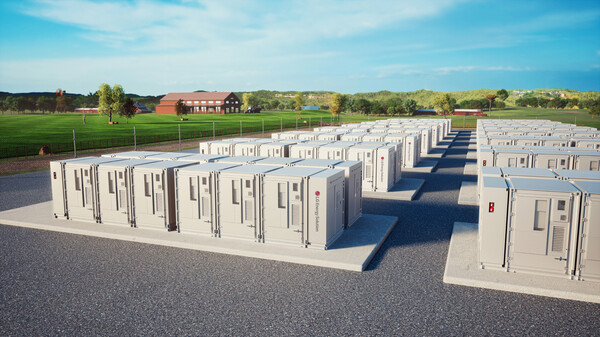
The U.S. government has designated battery energy storage systems (BESS) as facilities tied to national security. That is expected to lead to a string of second-half North American ESS orders for South Korea's three battery makers with production bases in the United States. LG Energy Solution is expected to win new ESS orders totaling 70 gigawatt-hours (GWh) in the second half alone, while SK On has already secured a contract to supply 9 GWh over five years. Samsung SDI is converting an electric vehicle joint-venture plant into an ESS line.
The U.S. government signed an executive order last month defining power grid facilities as national security-related. The order defines transmission networks of 69,000 volts (69 kV) or higher as a "bulk power system" and includes transformers, high-voltage circuit breakers, inverters, BESS, generators and industrial control systems as covered equipment. As the United States strengthens a policy of prioritising U.S.-made products in federal energy infrastructure procurement, companies with local production facilities are expected to gain competitiveness. The point at which the regulation effectively operates is whether manufacturing takes place in the United States.
South Korea's three battery makers have ESS production bases in the United States. LG Energy Solution's U.S. ESS production capacity stands at about 57 GWh, and Samsung SDI is expected to secure 20 GWh in North America by the end of this year. In particular, SK On has local capacity of about 100 GWh, combining a standalone plant and a joint venture plant with Hyundai Motor Group. On Aug. 31, SK On signed a battery cell supply contract with U.S. ESS company NeoVolta Power. Under the deal, it will supply 9 GWh of lithium iron phosphate (LFP) pouch battery cells over five years from 2027 to 2031, with volumes produced at a plant in the state of Georgia.
LG Energy Solution's target for new ESS orders this year is 90 GWh. IBK Investment & Securities said new orders in the first half were about 20 GWh, meaning the company needs to fill 70 GWh in the second half. LG Energy Solution said at a briefing that its third-quarter ESS shipments are expected to rise by more than 50 percent from the previous quarter and that North American output in the second half is expected to more than double the first half. It also said it is pursuing orders for big tech AI data centre projects and is discussing a direct delivery 방식 of batteries with some customers.
Samsung SDI is shifting electric vehicle production facilities to ESS to meet volumes. Samsung SDI has secured production infrastructure by converting a 36 GWh joint venture with GM into a standalone entity. Daishin Securities forecast Samsung SDI's third-quarter North American ESS revenue will rise 25 percent from the previous quarter and that an Advanced Manufacturing Production Credit (AMPC) subsidy of 121.7 billion won will be reflected. SK On has been expanding its local customer base. In September last year, it signed a 1 GWh ESS supply contract with renewable energy developer Flatiron.
Third-quarter ESS shipments to rise 50 percent; second-half North America output seen doubling
LG Energy Solution said it is expanding supply capacity for cells, packs and containers at the same time and will push mass production of LFP prismatic batteries in 2027 and the commercialisation of sodium-ion batteries for long-duration ESS. It also set a goal of expanding high value-added business by bundling system integration (SI), operations and maintenance (O&M) and energy management software. It plans to move to pre-empt the market by developing a standard platform for AI data centres.
SK On is pushing to supply an additional 9 GWh of LFP cells for ESS on a consignment-supply structure through a separate contract within the year. If completed, the scale of cooperation with NeoVolta Power will increase to 18 GWh. Mirae Asset Securities analysed that Samsung SDI could secure orders as its financial strength and prismatic form factor converge with tighter regulations against China. An industry official said the company operates flexibly to match customer demand and can respond because a significant portion of equipment can be used in common.
 Seok Dae-geon
d2dg@d-today.co.kr
Seok Dae-geon
d2dg@d-today.co.kr