
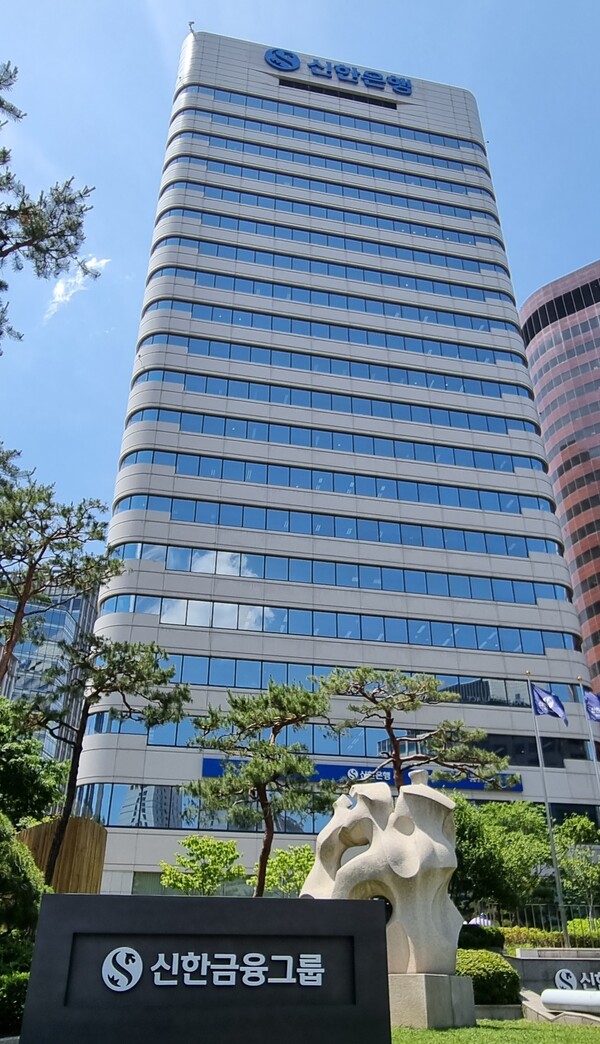
Shinhan Financial Group posted net profit in the mid-3 trillion won range in the first half of this year, supported by growth in its capital markets businesses such as brokerage and asset management. As contributions from non-interest income and non-bank units expanded, it also presented a shareholder return plan exceeding 2.8 trillion won for the full year.
Shinhan Financial said on Wednesday first-half net profit rose 13.3 percent from a year earlier to 3.44 trillion won, the highest on record. Second-quarter net profit was 1.82 trillion won, up 12.2 percent from the previous quarter.
First-half net interest income rose 7.7 percent from a year earlier to 6.16 trillion won. The group's net interest margin (NIM) was 1.93 percent and the bank's NIM was 1.60 percent, improving by 0.03 percentage points and 0.05 percentage points, respectively, from a year earlier.
Non-interest income rose 19.7 percent to 2.64 trillion won. As fee income increased, centered on securities custody commissions, the share of non-interest income in total earnings rose 2.2 percentage points to 30 percent.
Performance improvement in the capital markets segment was particularly pronounced. Profit and loss in the capital markets segment, including brokerage and asset management, rose 126.5 percent from a year earlier to 652.7 billion won. Shinhan Investment Corp's net profit rose 123.1 percent to 577.7 billion won and Shinhan Asset Management's net profit rose 135.1 percent to 53.6 billion won. The share of profit and loss from non-bank units expanded 5.3 percentage points to 35 percent.
Among major affiliates, Shinhan Bank posted first-half net profit of 2.46 trillion won, up 8.5 percent from a year earlier. Shinhan Card posted 253.4 billion won, up 2.8 percent, and Shinhan Capital posted 94.7 billion won, up 48.1 percent. Shinhan Life posted 290.6 billion won, down 15.6 percent, due to a decline in insurance profit as the difference between expected and actual insurance payouts widened.
Shinhan Bank's won-denominated loans at end-June rose 1.8 percent from end-December. Corporate loans rose 2.8 percent, while household loan growth was 0.5 percent. Within corporate loans, loans to small and medium-sized companies rose 1.8 percent and loans to large companies rose 6.6 percent. The bank's delinquency ratio was 0.34 percent and the ratio of substandard or below loans was 0.31 percent.
Credit loss costs declined. First-half provisioning for loan losses fell 10.8 percent from a year earlier to 949.8 billion won and the credit cost ratio was 0.42 percent. Selling, general and administrative expenses rose 10.9 percent to 3.22 trillion won due to voluntary retirement costs and inflation, but the cost-income ratio (CIR) held at 36.6 percent.
First-half net profit from overseas operations rose 9.5 percent to 472.5 billion won, supported by growth at its Japan and Vietnam units. At end-June, the group's common equity tier 1 (CET1) ratio rose 0.13 percentage points from the previous quarter to 13.43 percent, and the Bank for International Settlements (BIS) capital ratio was provisionally calculated at 15.74 percent.
Shinhan Financial will also expand shareholder returns based on improved performance. The board set a second-quarter dividend of 740 won per share and decided to additionally buy back 700.0 billion won worth of treasury shares by October for cancellation. As a result, this year's total treasury share buyback and cancellation is expected to exceed 1.40 trillion won.
The annual cash dividend is also expected to be about 1.40 trillion won, taking this year's total shareholder return to 2.80 trillion won plus alpha. Shinhan Financial plans to announce the size of additional treasury share purchases in the fourth quarter, considering expected performance and capital adequacy.
A Shinhan Financial official said it would raise return on equity (ROE) and capital efficiency based on "Shinhan Value-Up 2.0". The official said it would continue to push ahead with shareholder return policies to enhance shareholder value and contribute to vitalising capital markets by increasing consistency and predictability in its capital policy.
 Ji-young Lee
ljy@d-today.co.kr
Ji-young Lee
ljy@d-today.co.kr