
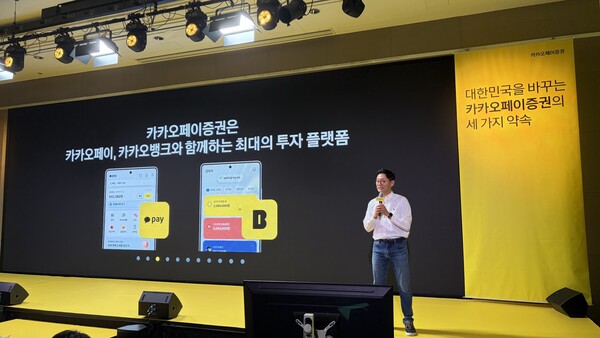
KakaoPay Securities has set a goal of ushering in an era of 20 million investors within three years by using an artificial intelligence (AI) investment agent and platforms run by Kakao affiliates. In the first half of next year, it will launch a service for U.S. investors to invest in South Korean stocks and, over the longer term, is also reviewing 24-hour trading through tokenisation.
KakaoPay Securities CEO Shin Ho-cheol (신호철) said at a press briefing in Seoul on Wednesday that the goal is not to open as many accounts as possible, but to create an era in which more people invest properly and grow their assets. He said the company would provide every customer with an investment agent that knows them best.
KakaoPay Securities is developing an AI investment agent that provides information tailored to customers' investment tendencies and level of knowledge. It is aiming for “explainable AI” that allows customers to check not only the recommendations but also the basis for those judgments and the data used.
The AI is designed to help customers decide by explaining a product’s structure, risks and expected returns, rather than unilaterally recommending products. Some functions are set to be introduced within this year. The company is also reviewing ways to connect the investment agent to messenger services including KakaoTalk.
Shin said the company set a principle of building AI that speaks from the customer’s side, not the brokerage’s. He said it is important to help customers properly understand what they choose, even though the investment decision is made by the customer.
The company has also placed its in-house research organisation inside its AI service centre. Rather than producing large volumes of reports, it will focus on verifying the reliability of information flooding the market and selecting what customers need. It also plans to provide AI-based analytical tools so customers can analyse companies like analysts.
It is also expanding customer touchpoints linked to Kakao affiliates. KakaoPay Securities has secured more than 8.5 million stock accounts, and 100,000 to 200,000 new accounts are being opened each month.
From August, it plans to allow users to access KakaoPay Securities' stock trading service through KakaoBank. It is also preparing to launch fractional trading for domestic stocks that month.
On the gap with rival Toss Securities, Shin said the company is in a catch-up phase because it was late to launch its mobile trading system for stocks. He added that it has begun to use the Kakao ecosystem in earnest and that revenue has grown by about 75 percent each year over the past three years.
It is also pushing a “K-stocks global gateway” project to improve access to South Korean stocks for overseas investors. KakaoPay Securities plans to launch the related service in the United States in the first half of next year in cooperation with Siebert Financial, a U.S. brokerage in which KakaoPay holds about a 20 percent stake.
The plan is not limited to brokering orders for South Korean stocks, but to integrate KakaoPay Securities' investment content, user interface and user experience (UI/UX), and investment community into Siebert Financial’s service. The two companies have held weekly working-level consultations since signing a business agreement in May.
To address the time difference between the United States and South Korea, a plan to tokenise South Korean stocks for 24-hour trading has also been put on the table. It is one of the alternatives Siebert Financial is reviewing within the U.S. regulatory framework, while KakaoPay Securities is communicating with financial authorities over domestic laws and investor protection issues.
Shin said tokenisation has the advantage of reducing constraints on trading hours and enabling real-time settlement. He added that it could also raise market volatility by speeding up capital flows and should be approached cautiously within the scope of regulation.
It will also expand its investment banking business. Based on its investment dealing licence obtained this month, KakaoPay Securities will first 추진 the underwriting of initial public offerings (IPOs) and public subscription business. Over the medium to long term, it plans to broaden the scope to include exchange-traded fund (ETF) liquidity provider (LP) work and a sales and trading business.
It is putting more weight on supplying venture capital such as to startups than on real estate project financing (PF). The idea is to use startup networks held by Kakao Ventures and Kakao Investment to link the process from investment to listing.
It ruled out a separate listing or any immediate plan to raise capital. Shin said he understands there is no plan to list KakaoPay Securities separately and that capital is sufficient to run its current retail business. He added it can secure needed capital through cash flow generated from operating activities.
KakaoPay Securities is also pursuing a stock-gifting business to broaden participation in investing. Following gifting shares to couples getting married this year, it plans to provide shares worth 100,000 won per child to all babies born in 2027. Based on 200,000 newborns, the expected cost is about 20 billion won.
Shin said shares received on the day a baby is born can naturally become the starting point for financial education. He added the company will focus on lowering the threshold to start investing and helping customers grow into proper investors.
 Oh Sang-yup
yub@d-today.co.kr
Oh Sang-yup
yub@d-today.co.kr