
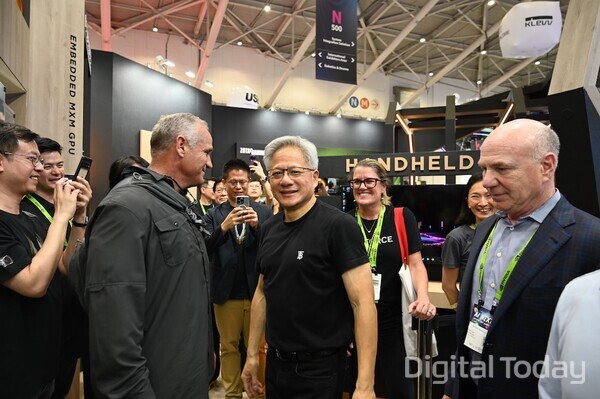
[DigitalToday reporter Seok Dae-geon] The chiefs of Samsung Electronics, SK and Naver will meet Nvidia Chief Executive Jensen Huang in the United States this week. It will bring together leaders of South Korean memory and platform companies around Nvidia, with attention on how far discussions on cooperation between South Korean and U.S. companies over artificial intelligence infrastructure will expand.
Industry officials said on July 22 that Samsung Electronics Chairman Lee Jae-yong (이재용), SK Group Chairman Chey Tae-won (최태원) and Naver Chairman Lee Hae-jin (이해진) will meet Huang in a roundtable format near Silicon Valley this week. July 24 is seen as the most likely date. The possibility that OpenAI CEO Sam Altman and Anthropic CEO Dario Amodei will join has also been mentioned.
For Huang, it would be a reunion about a month after his visit to South Korea in early June. He met executives from Samsung, SK, Hyundai Motor, LG and Naver in succession at the time. The move to arrange another meeting after a short interval is seen as a signal that he places significant weight on tightening supply-chain ties with South Korean companies.
Items on the agenda differ by company. For Samsung Electronics and SK hynix, the core issue is their high-bandwidth memory supply relationship with Nvidia. The two companies decided to put HBM4 into Nvidia's next-generation AI accelerator "Vera Rubin" due in the second half. They are also supplying memory for OpenAI's in-house AI chip under preparation. They also reached an agreement last year to supply high-performance memory for the AI infrastructure project "Stargate," worth hundreds of trillions of won.
Samsung Electronics is also taking charge of foundry production for the inference language processing unit (LPU) "Grok 3" to be used on the Nvidia platform. It is also discussing contract manufacturing of AI chips using a 2-nanometre process with Anthropic. Naver is expected to put forward a cooperation plan linked to building an "AI factory" at the meeting. An AI factory refers to a facility that combines AI models and cloud services with physical infrastructure such as GPU servers, data centres, and power and cooling equipment to handle large-scale computing.
OpenAI and Anthropic, which are being mentioned as potential participants, are companies leading the generative AI services market with ChatGPT and Claude, respectively. That would put supply-chain players from each stage at one table, from Samsung and SK supplying memory, to Nvidia designing chips, to Naver, OpenAI and Anthropic selling services. It is also an extension of a trend in which U.S. big tech has been widening its points of contact with South Korean semiconductor companies.
Business circles see the meeting as also pushing back against recent concerns about a semiconductor peak-out. They say it will confirm through face-to-face talks with U.S. big tech that South Korean companies are moving beyond memory supply into the AI infrastructure design stage. In the market, the prevailing view is that AI investment capacity will remain solid over the next 2 to 3 years and that a memory supply shortage will continue into next year.
AI leader meeting ahead, South Korean and U.S. stocks also rebound
South Korean stocks rose sharply for a second straight day ahead of the meeting. The Korea Exchange said the KOSPI was at 7,113.23 at 10:05 a.m. on July 22, up 5.41 percent from the previous session. It regained the 7,000 level for the first time in 4 trading sessions, and it surged 6.01 percent shortly after the open, triggering a buying sidecar. In the main board market, both-direction sidecars were triggered for a third consecutive day.
Foreign investors drove the rally. Foreigners posted net buying of 1.6031 trillion won on the day, and they have bought a total of 2.2017 trillion won so far this week, returning to a net buying stance for the first time in 12 weeks. Individuals and institutions sold 1.04 trillion won and 565.1 billion won, respectively. Samsung Electronics and SK hynix rose 5.50 percent and 8.12 percent, respectively, and Asian stock markets including Japan's Nikkei 255 and Taiwan's TAIEX also advanced.
Gains on Wall Street also contributed to the rebound. Memory stocks rose broadly, with Micron up 12.17 percent and SanDisk up 14.27 percent, lifting the Philadelphia Semiconductor Index 5.21 percent. News that Vera Rubin has entered mass production and started being supplied to major clients eased concerns about a slowdown in AI investment. An assessment that Chinese firm Moonshot AI's new model "Kimi K3" requires large volumes of memory also supported expectations that supply shortages will persist longer.
Assessments by investment banks also helped restore sentiment. UBS said the recent decline was not due to damaged fundamentals but a supply-demand shock from hedge funds reducing positions, and it saw selling pressure as having eased substantially. Morgan Stanley said the KOSPI was approaching a bottom and maintained its target of 9,000.
 Seok Dae-geon
d2dg@d-today.co.kr
Seok Dae-geon
d2dg@d-today.co.kr