
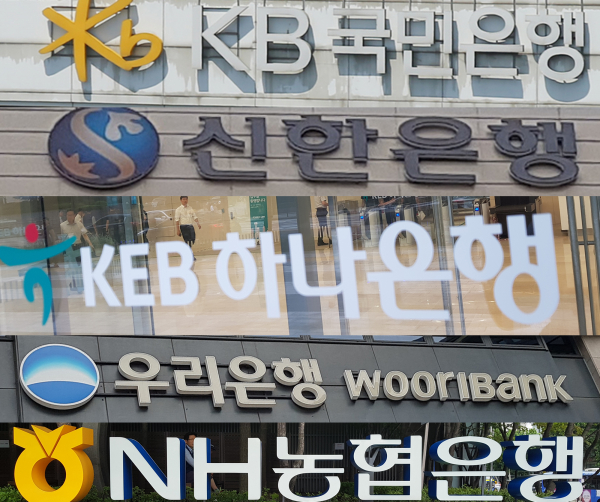
The terms of the chiefs of South Korea’s five major banks all end at the close of this year, emerging as a key issue for the financial sector in the second half.
The financial sector said on Tuesday that the terms of KB Kookmin Bank CEO Lee Hwan-ju (이환주), Shinhan Bank CEO Jeong Sang-hyeok (정상혁), Hana Bank CEO Lee Ho-seong (이호성), Woori Bank CEO Jeong Jin-wan (정진완) and NH NongHyup Bank CEO Kang Tae-young (강태영) all expire on Dec. 31. Under best practices for financial company governance, succession procedures must begin at least three months before a term ends. That means full-scale selection work is expected to start by September at the latest.
The financial sector is placing greater weight on management continuity through reappointments than on a large-scale reshuffle. That is because KB Kookmin, Hana, Woori and NongHyup banks all appointed new chiefs at the end of 2024, and bank chief terms are typically run on a “2 years plus 1 year” structure, with many cases allowing a one-year extension after a first term.
Lee at KB Kookmin is receiving a relatively stable assessment on performance. KB Kookmin posted 3.862 trillion won in net profit last year, up 18.8 percent from a year earlier. Observers say Lee is likely to be reappointed unless special internal control factors arise, as the bank has shaken off the cost burden tied to the Hong Kong H-index equity-linked securities (ELS) incident and restored profitability. Still, there remains a possibility that the group’s affiliate CEO lineup could be adjusted depending on the outcome of the selection of the KB Financial Group chairman.
Jeong at Shinhan is receiving positive assessments for management performance, but the burden of a long tenure and whether to pursue generational change are cited as variables that could decide his future. Since taking office in 2023, Jeong has led Shinhan Bank’s net profit growth and competition for the leading bank position, and at the end of 2024 he was granted an additional two-year term, longer than the typical one-year extension. Another extension cannot be ruled out, but there are simultaneous concerns about the burden of a longer overall tenure and calls for generational change centered on executives born in the 1970s.
Lee at Hana is also being mentioned as a possible reappointment. Hana Bank’s net profit last year was 3.7475 trillion won, up 11.7 percent from a year earlier. Solid performance led by foreign exchange and corporate finance is viewed positively, but there are forecasts that Lee could also change his role within the group, as many past Hana Bank chiefs moved to positions such as vice chairman of the holding company after completing their terms.
Jeong at Woori is seen as having second-half performance as a key indicator that will decide whether he is reappointed. Since taking office, he has focused on organisational stability and strengthening internal controls, but Woori Bank’s net profit last year fell 14.2 percent from a year earlier to about 2.6066 trillion won. He faces pressure to recover relatively weak performance among the five major banks while also proving management capability in follow-up measures over a recently surfaced personal data leak issue.
Kang at NH NongHyup faces the biggest variable in a group-wide drive for renewal across NongHyup. NongHyup Bank posted 1.814 trillion won in net profit last year, but a change is also being mentioned given that many past NongHyup Bank chiefs typically stepped down after serving two-year terms. The personnel direction of the federation and the financial holding company is also assessed as having a relatively larger influence on the bank chief selection than at other banks.
Financial regulators’ discussions on governance reform are also expected to act as a variable in year-end appointments. The Financial Services Commission launched a “governance advancement task force” in January to boost board independence and increase fairness and transparency in CEO selection. The financial sector believes regulators may present an improvement plan within this month, but specific details, including limits on CEO reappointments, have yet to be finalised.
There are also criticisms that holding company chairmen have strong influence in the process of selecting bank chiefs. Most financial holding companies currently operate a structure in which a holding company recommendation committee selects a single bank chief candidate and a bank executive candidate recommendation committee verifies it, drawing criticism that the bank committee’s role is merely formal. Regulators are known to be considering measures to increase transparency in selection procedures, including having the bank committee recommend candidates to the holding company.
As a result, another key variable for year-end appointments is whether regulators’ improvement plan can materially change a chairman-centered succession structure at holding companies, beyond reasons such as performance improvement.
A financial industry official said, “For now, weight is placed on management continuity through reappointments, but there are various variables such as regulators’ governance discussions.”
 Lee Ji-young
ljy@d-today.co.kr
Lee Ji-young
ljy@d-today.co.kr