
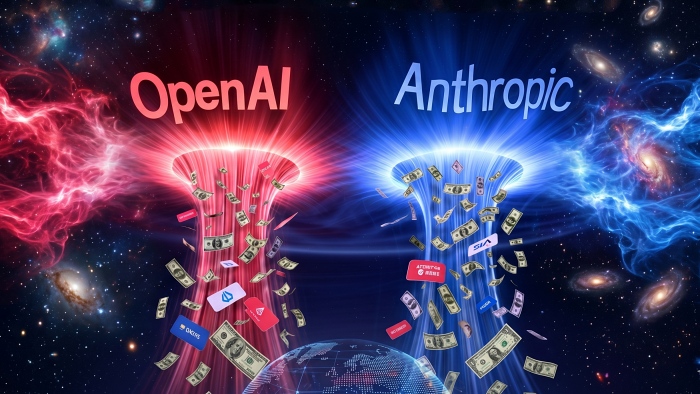
As AI increasingly evolves into a commodity that many companies can use widely, OpenAI and Anthropic appear to be losing some of their earlier standing in the global AI market.
A recent Wall Street Journal report said that as knowledge for developing advanced AI spreads and many companies provide sufficiently usable AI at relatively lower prices than OpenAI and Anthropic, the competitive advantage and entry barriers the two firms enjoyed - their so-called moat - could weaken.
OpenAI and Anthropic have led the global AI market by selling higher-performing AI models at relatively high prices, but it is unclear whether they can keep doing so as AI becomes more commoditised.
Chinese AI startups such as DeepSeek, Z.ai and Moonshot AI, along with Chinese big tech companies such as Alibaba, are releasing cheaper AI that rivals the top models from OpenAI and Anthropic. In the United States, Meta and Thinking Machines Lab have also emerged as new challengers that threaten OpenAI and Anthropic.
OpenAI and Anthropic could widen the gap again through research and development, but some analysis says it will be difficult to stop AI commoditisation given the AI market’s tendency for technical details to be widely disclosed externally.
AI engineers, including researchers at companies, continually disclose new research results in the form of papers. Chinese AI companies and new AI startups such as Thinking Machines Lab are also releasing open-source models, along with technical reports that detail model development processes and training methods, the WSJ reported.
Distillation, which trains an AI model using another model, is also accelerating AI commoditisation.
OpenAI and Anthropic accuse Chinese companies of using distillation to develop AI models with their own data, but distillation itself is not illegal. Distillation is widely used for lawful purposes. AI companies use distillation to train small models that run cheaply and quickly using large models, and Apple’s newly unveiled Siri AI-based model was also developed by distilling a Google AI model under a contract between Google and Apple, the WSJ reported.
Satya Nadella (사티아 나델라), Microsoft CEO, recently drew attention by defending distillation, unlike OpenAI and Anthropic. In a recent essay, he said it was "ironic" that AI companies train models using information collected from the internet as well as their own customer data, while seeking to restrict other companies from using distillation.
Given the difficulty of maintaining the kind of technological gap seen in the past, OpenAI and Anthropic appear to need to speed up efforts to build new moats.
OpenAI appears to be accelerating efforts to diversify its revenue model. It has secured more than 3 million business customers and is developing its own hardware to build direct relationships with individual users.
Anthropic’s strategy is to pursue an initial public offering as quickly as possible and use it to expand its influence.
Anthropic recently posted a quarterly profit for the first time, and an IPO would provide ammunition for it to secure more customers and data centre infrastructure and to find new revenue sources, the WSJ reported.
Some forecasts also say that the ability to secure sufficient power will be an important competitive advantage for AI companies.
Eric Zhao (에릭 자오), a professor at the University of Oxford, said in a recently co-authored paper that the most important competitive advantage for AI companies in the future will be the ability to secure power. As power supply and demand become increasingly difficult and local opposition makes it hard to build and expand data centres, how efficiently companies use limited power is expected to emerge as a key competitive factor. "State-of-the-art AI companies will compete in the future on 'intelligence per watt'," he said.
 Chi-gyu Hwang
delight@d-today.co.kr
Chi-gyu Hwang
delight@d-today.co.kr