
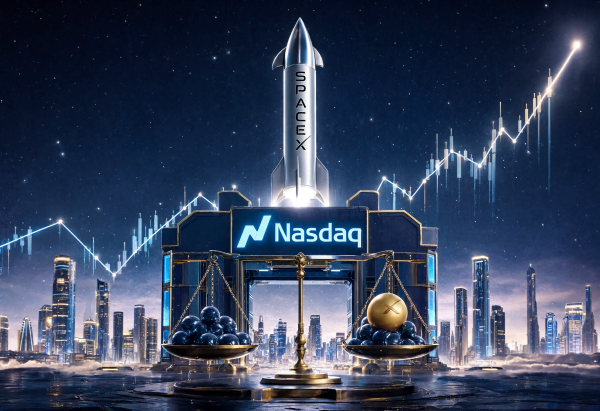
SpaceX’s early inclusion in the Nasdaq 100 led related index funds to automatically add the company’s shares, but an assessment said it is hard to see it as a structural risk serious enough to avoid index investing itself.
On July 20, IT outlet The Verge reported that the key variable lies not so much with SpaceX itself as with how index funds are structured and how stocks are included in the index.
The change followed Nasdaq revising its rules to allow large companies to be added to the Nasdaq 100 more quickly soon after listing. SpaceX was added to the Nasdaq 100 on July 7. Index funds are designed to track the returns of a set market index such as the KOSPI 200 or the S&P 500, so they had to buy the stock. The market had anticipated such demand even before the listing, and an explanation says this kind of structural trading was reflected in the share price moves around the inclusion.
Index funds are products that track the overall market rather than picking individual stocks. The logic is that because even experts find it difficult to consistently predict which stocks will surge over the long term, tracking the market average at low cost is advantageous for ordinary investors. Burton Malkiel (버튼 말키엘), cited as a figure who helped spread index funds, said of SpaceX that if it were an individual-stock investment he would "be cautious about buying" and that it is "excessively overvalued". Malkiel, however, drew a line by saying SpaceX’s inclusion is not a reason to avoid index funds.
Malkiel also stressed that market returns come from a small number of stocks. "Most of the total return is created by a very small number of stocks," he said. "Even experts cannot pick those stocks better than the overall index," he said. That means even if a controversial company like SpaceX is included, index investors also hold the small number of stocks that drive long-term returns.
Short-term variables remain. SpaceX is a giant company with a market capitalisation of more than $1.5 trillion, but less than 5 percent of its shares were actually released to the market in the initial public offering. Nasdaq adjusts index weightings to reflect such free-float levels, so its current influence in the index is not as large as its market capitalisation. But as lockup shares are released sequentially from next month, the free float could increase and its index weighting could change. There was also speculation that after the company releases second-quarter results, 180-day lockup holders could sell more shares into the market than the initial offering amount.
In that case, index-fund money could play a role in absorbing some of the selling. If the share price falls, the index weighting also drops, and index funds’ holdings are automatically adjusted as well. That is why single-stock risk does not immediately shake the whole index.
Still, a key issue left by SpaceX’s inclusion is corporate governance. With Elon Musk holding a majority of voting rights, other shareholders’ influence is limited, and shareholder litigation rights are narrower than at typical listed companies, a critique said. The chief executive of CalPERS, the United States’ largest public pension fund, and audit officials from New York state and New York City took issue with SpaceX’s new and extreme governance structure. Once a company is included in an index fund, it is not easy to avoid it because of the automatic inclusion mechanism.
This case may not stop with SpaceX alone. A Harvard Business School study said automatic buying by index funds can affect early surges in newly listed stocks. SpaceX could also become a precedent for future listings of large technology companies. With Anthropic and OpenAI also expected to list within this year, the impact of early index inclusion of large technology stocks on investment flows is expected to grow.
Criticism of index funds also persists. Critics say a small number of large companies take an excessive share of index weightings, and distortions arise in rebalancing, with funds buying high and selling low. But Malkiel said, "The market was concentrated to begin with," and did not see it as a reason to deny index investing itself. "We do not know what will become the best stock now and what will fail," he said.
In the end, SpaceX’s inclusion could increase short-term volatility in products tracking the Nasdaq 100, but it is hard to see it as something that undermines the basic logic of index funds. Still, Musk’s governance structure, an expansion of free float after lockups expire, and additional listings by large technology companies remain variables index investors need to keep watching.
 Seung-a Yoo
ysah@d-today.co.kr
Seung-a Yoo
ysah@d-today.co.kr