
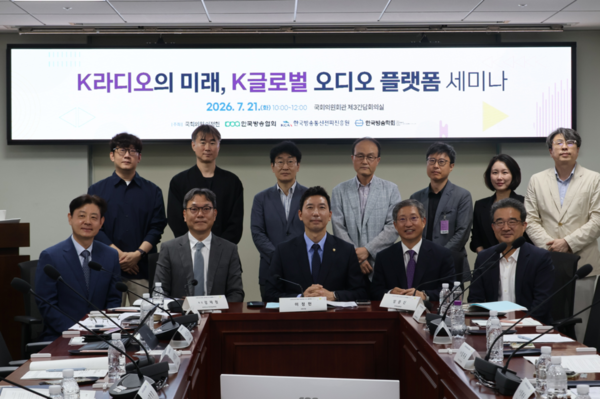
As the influence of global platforms such as YouTube and Spotify expands into South Korea’s audio market, a call has emerged for a platform that integrates radio content and data that are currently scattered across broadcasters into one.
Lee Jung-heon (이정헌), a lawmaker of the Democratic Party and a member of the National Assembly Science, ICT, Broadcasting and Communications Committee, held the seminar "The Future of K-Radio, K-Global Audio Platform" at the National Assembly on July 21 with the Korea Broadcasters Association, the Korean Association for Broadcasting & Telecommunication Studies and the Korea Communications Agency.
Participants said South Korea should integrate production and digital capabilities in domestic audio content and build a data-centric industry base to improve listener access.
Lee said, "With a fragmented app ecosystem, user churn from domestic radio has accelerated and the shift to data-based services has also been delayed," adding, "The National Assembly will do its utmost to provide policy and legal support for a major transformation of the K-radio industry."
Bang Moon-shin (방문신), chairman of the Korea Broadcasters Association, said, "Europe, Japan and Australia, among others, are using integrated platforms to maintain radio competitiveness even in the digital era," adding, "With the 100th anniversary of radio ahead, now is the golden time for public interest, support and investment."
Kim Kwang-jae (김광재), a professor at Hanyang Cyber University who delivered a presentation, said the contraction of South Korea’s radio industry stemmed from gaps in responding to digital transformation rather than from the nature of audio as "listening content". Kim cited Britain’s "Radioplayer", Australia’s "Listener" and Japan’s "Radiko" as examples of securing digital readiness through integrated radio platforms.
Kim said, "As of 2024, radio advertising spending in major overseas countries is 4.5 to 6.6 times higher than in South Korea, and usage rates are 2.9 to 4.8 times higher," adding, "In South Korea, an institutional foundation to effectively guarantee digital accessibility for audio media is virtually absent."
Kim proposed that alongside building an integrated platform, South Korea should legislate "digital radio access rights" so radio can be easily searched and used in connected environments. He also said advertising regulations, including title sponsorship and product placement, need to be overhauled.
In the discussion, participants stressed the need for an industry structure that can link listener data secured through an integrated platform to advertising and revenue.
Kang Shin-gyu (강신규), a principal research fellow at the Korea Broadcast Advertising Corp, said, "It is important to incorporate listener data generated on an integrated platform into existing audience measurement surveys and advertising sales systems."
Im Jae-yoon (임재윤), in charge of audio digital strategy at MBC, said, "In the past, radio made it easy to move across multiple channels on a single device, but in the digital environment it has been fragmented into each company’s app and accessibility has instead deteriorated," adding, "Industry infrastructure should be strengthened so consistently measured data can translate into revenue."
Lee Kyung-ryeol (이경렬), deputy head of SBS Radio 1CP, said, "If we secure unified data through an integrated platform, we can raise the value of radio advertising and expand the market size."
 Jin-ho Lee
jhlee26@d-today.co.kr
Jin-ho Lee
jhlee26@d-today.co.kr