
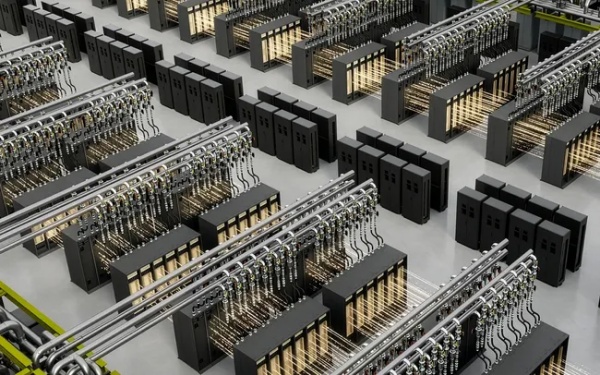
Japan's government is working with Nvidia to build national-level artificial intelligence (AI) infrastructure. The move is a strategy to secure competitiveness in physical AI used in robots and industrial automation. Up to 1 trillion yen is expected to be invested over the next 5 years.
On July 20 local time, IT outlet TechRadar reported that Japan's Ministry of Economy, Trade and Industry will support cooperation between AI consortium NOESTRA and Nvidia to 추진 a national AI project called "FRONTIA".
NOESTRA is a consortium involving 44 companies and research institutions including NEC, Sony, Honda and SoftBank. It was selected on June 30 as the operator of FRONTIA, and the project runs until 2030.
FRONTIA is core infrastructure for an Japan-led AI ecosystem. Its goal is to provide computing resources needed to develop high-performance multimodal foundation models for use in industrial sites, and to build a physical AI ecosystem based on that for real-world physical environments including robots, industrial equipment and healthcare.
Japan's economy minister Ryosei Akazawa (아카자와 료세이) introduced FRONTIA as "the core of Japan's physical AI ecosystem" and said Japan would work with global technology companies including Nvidia based on Japan's manufacturing technology and industrial-site data. He outlined a plan to develop highly reliable multimodal AI models to strengthen industrial competitiveness and contribute to solving global social problems.
The project is expected to introduce infrastructure based on Nvidia's next-generation AI platform "Vera Rubin". Once the build-out is completed, companies in Japan and AI developers will be able to jointly use the multimodal AI models developed by NOESTRA. Nvidia's AI software and libraries are also planned to be provided.
The project is viewed as a national strategy to combine Japan's strengths in manufacturing with Nvidia's AI technology. Japan has set a goal of securing AI competitiveness specialized in robots and industrial automation by using data accumulated in manufacturing sites, and of taking the lead in physical AI that operates in real industrial environments beyond generative AI.
Nvidia founder and Chief Executive Jensen Huang (젠슨 황) said, "Japan is the country that gave birth to modern manufacturing," and added, "Now it is building AI factories that will lead the next industrial revolution." He added that he finds it meaningful that Nvidia will participate in building AI infrastructure with Japanese industry to support national industry, the economy and future innovation.
Concerns are also being raised around the large-scale project. Critics say transparency is insufficient in the budget execution process of NOESTRA and the Japanese government, and some say reliance on a U.S. company, Nvidia, for core infrastructure could become controversial in terms of technological sovereignty.
The huge power consumption and cost burden needed to operate ultra-large AI infrastructure are also cited as tasks to be addressed. Industry players say that if the FRONTIA project succeeds, it could become an opportunity for Japan to secure manufacturing-based physical AI competitiveness. They expect discussions to continue over job changes from the spread of automation, technological sovereignty and energy costs.
 Jinju Hong
hongjj@d-today.co.kr
Jinju Hong
hongjj@d-today.co.kr