
Sixty-eight percent of Taiwan fabs are experiencing bottlenecks due to compatibility problems between equipment. As Japanese equipment makers stick to proprietary standards, South Korean tool suppliers are moving to target Taiwan’s semiconductor logistics automation market with AI-based integrated control solutions.
According to Intel Market Research, the Taiwan government is running a 15.4 billion Taiwan dollar ($500 million) “semiconductor automation programme.” With TSMC building more than 10 new plants across Taiwan, demand for logistics automation infrastructure is surging.
The problem is compatibility. Equipment manufacturers are implementing exclusive functions to differentiate their products, and such compatibility issues are persisting. These mismatches require customised adjustments or additional verification processes, increasing operational complexity and total cost of ownership (TCO).
For example, 68 percent of Taiwan fabs experience mechanical interface problems when using FOUP wafer carriers between different equipment brands, Intel Market Research said. In processes of 3 nanometres and below, stricter contamination control requirements make the situation more serious. Foundries at 3 nanometres and below replace carriers up to 50 percent more frequently than at 7 nanometres, it explained.
An analysis also points to the problem being worsened as the Japanese equipment industry, an established leader, insists on proprietary standards. Japanese companies such as Daifuku focus on OHT hardware performance, while being passive about integrated control between different types of equipment, it said.
On the ground, the industry is demanding integrated capabilities that control the entire process, rather than simple transport performance as in the past. That is because the logistics automation market is being reshaped into an Industry 4.0 integrated environment. According to Intel Market Research, smart devices equipped with embedded sensors are forecast to account for 35 percent of the market by 2027. Companies adopting smart monitoring cut wafer scrap rates by 22 percent.
South Korean equipment suppliers are moving into this niche. While Japan focuses on hardware, South Korean suppliers are providing smart factory integrated control solutions combining AI and robot control technologies.
SFA is promoting an integrated smart AMHS (automated material handling system) solution combining AI and digital twin technologies. It recently supplied a smart logistics system to an HBM line, demonstrating its technical capabilities. Its strength lies in integrating equipment of different types to resolve bottlenecks.
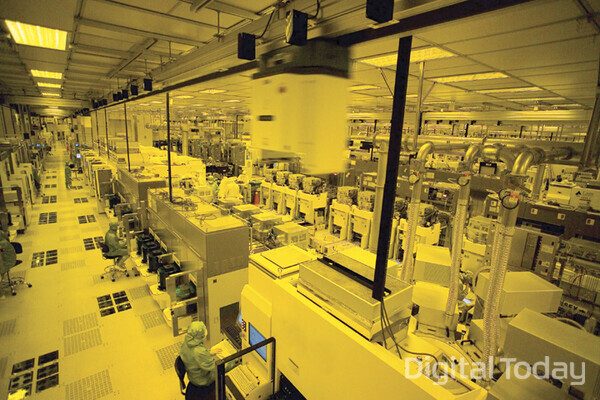
SEMES had already shipped 10,000 mass-produced units of OHT (Overhead Hoist Transport) as of 2024. OHT is an automation system that transports FOUP wafer carriers to each process tool along fixed rails installed on the ceiling of a semiconductor line. Since developing it independently, it has generated an import substitution effect of several hundred billion won a year. Koh Young Technology also provides automatic error identification and real-time equipment optimisation functions with its AI-based process optimisation platform, “KSMART.”
An industry official said, “In ultra-fine processes of 3 nanometres and below, even small mismatches between equipment directly lead to yield declines.” The official added, “Integrated capabilities to read and coordinate the flow of the entire line will become more important.”
 Daegeon Seok
d2dg@d-today.co.kr
Daegeon Seok
d2dg@d-today.co.kr