
All members of South Korea’s delegations won medals at the International Biology Olympiad and the International Chemistry Olympiad.
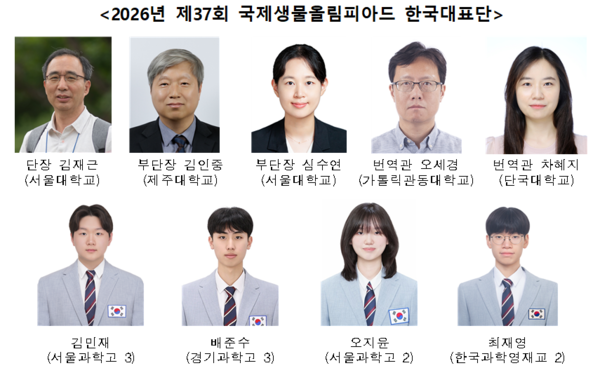
The Ministry of Science and ICT and the Korea Foundation for the Advancement of Science and Creativity said on July 21 that all 4 members of South Korea’s delegation won gold medals at the 2026 International Biology Olympiad.
The 37th International Biology Olympiad, held in Vilnius, Lithuania from July 12 to 19, drew 302 students from 78 countries. All South Korean representatives won gold medals: Minjae Kim (김민재), a third-year student at Seoul Science High School; Junsu Bae (배준수), a third-year student at Gyeonggi Science High School; Jiyoon Oh (오지윤), a second-year student at Seoul Science High School; and Jaeyoung Choi (최재영), a second-year student at Korea Science Academy of KAIST.
It is the first time since 2019 that all members of South Korea’s delegation have won gold medals at the International Biology Olympiad. This year’s event also had the largest number of participating countries and students since South Korea first took part in 1998.
The International Biology Olympiad reflected theory and lab assessment scores at 50 percent each. The theory assessment evaluated knowledge and scientific thinking across life sciences, including cell biology and genetics, evolution and ecology. The lab assessment focused on experimental performance and data interpretation, centring on areas such as molecular biology and biochemistry, animal physiology and plant computational biology.
All members of South Korea’s delegation also won medals at the 58th International Chemistry Olympiad held in Tashkent, Uzbekistan from July 10 to 19. Sangyeon Kim (김상연), a third-year student at Incheon Science Arts Gifted School, and Jangho Lim (임장호), a third-year student at Gwangju Science High School, won gold medals. Dohoon Kim (김도훈), a third-year student at Gwangju Science High School, won a silver medal, and Eunseong Lee (이은성), a third-year student at Daegu Science High School, received a bronze.
This year’s International Chemistry Olympiad drew 368 students from 92 countries. It reflected scores from a theory exam and a lab exam, each held for 5 hours, at a 60 percent and 40 percent weighting. The theory exam included problems in physical chemistry, analytical chemistry, organic chemistry and inorganic chemistry. The lab exam set tasks such as coordination compound synthesis, biological sample analysis and acid-base titration.
South Korea’s delegation is set to take part next in the International Mathematical Olympiad, the International Olympiad in Informatics and the International Earth Science Olympiad, following the biology and chemistry Olympiads.
 Jin-ho Lee
jhlee26@d-today.co.kr
Jin-ho Lee
jhlee26@d-today.co.kr