
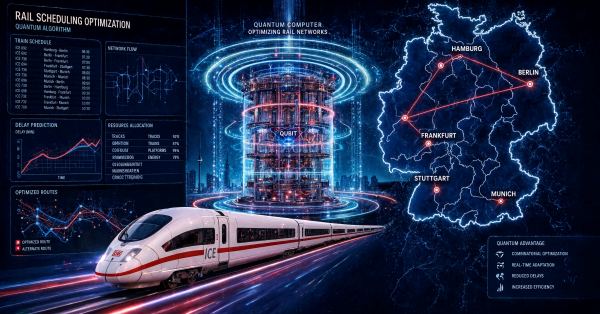
A scheduling test applying quantum computing to German rail operations data was conducted. It drew attention for tackling an industrial-scale optimisation problem by combining high-performance computing and a quantum processor based on real rail timetables.
Cryptopolitan, a blockchain outlet, reported on July 20 local time that IQM Quantum Computers and German state rail operator Deutsche Bahn carried out a hybrid quantum scheduling test on 190 rail routes in five German cities.
The test used real rail timetable data. The schedule combinations analysed totalled 98,500, a scale difficult for humans to review one by one. IQM divided the overall scheduling problem into multiple sub-problems in a high-performance computing environment and assigned some tasks to a quantum processor. Results calculated by the quantum computer were fed back into the overall system to build the final timetable.
Researchers used the quantum approximate optimisation algorithm, or QAOA, in stages. A classical computing system managed the overall rail operating plan, while a quantum processor handled specific detailed optimisation problems. The research results were included in a white paper released by IQM.
The test confirmed three main results. First, it demonstrated that usable rail timetables can be generated using currently available quantum hardware alone. This means companies and institutions can test quantum optimisation in real work through a hybrid approach even before fully fault-tolerant quantum computers emerge.
Performance also tended to improve as the scale of data processing grew. Researchers said they found a statistically significant relationship between the workload assigned to the quantum chip and the quality of the results. It was projected that if quantum processors improve, more complex and refined operating schedules could be created without major changes to the current software structure.
IQM explained that it carried out the entire processing flow, from input to output, directly on its system. It said this was not a simple simulation, but used real quantum hardware to handle the scheduling problem and produce usable results.
Ines de Vega (이네스 데 베가), a senior scientist at IQM, assessed the collaboration as showing that quantum computers have already advanced enough to handle industrial-scale optimisation problems. He said the test with Deutsche Bahn showed quantum computing can deliver practical value even now and presented a technical roadmap that can naturally scale as hardware performance improves.
Manfred Lick (만프레트 리크), Deutsche Bahn's head of quantum technology, also stressed that quantum computing is not a technology that will end as a temporary fad. He assessed that handling real industrial problems in an environment combining high-performance computing and quantum computing brought it one step closer to so-called "quantum advantage".
Still, the test was conducted based on a fixed schedule in which key operating conditions were set in advance. In real rail operations, unexpected variables such as train delays, track blockages and equipment failures occur frequently. Operating conditions can change in just minutes, making real-time response capability important.
Researchers forecast that as quantum hardware performance improves, the same hybrid structure could be used to calculate alternatives faster and support decision-making even in such volatile situations.
Global information technology companies are also moving to expand investment in quantum computing. IBM announced plans in June to invest $10 billion over the next five years and to unveil its first fault-tolerant quantum computer by 2029. The U.S. Commerce Department said in May that IBM would receive $1 billion in subsidies as it establishes a separate business entity, Anderlon, expected to be the first pure-play quantum foundry business in the United States.
IBM shares have reacted strongly whenever there were announcements related to quantum computing, but the pattern of sharp corrections has also repeated when expectations weakened. The company is set to announce its 2026 second-quarter results after the market closes on July 22. The market's earnings expectations have been somewhat lowered after an earlier negative preliminary disclosure.
The Deutsche Bahn test was assessed as an example showing the possibility of applying quantum computing to real industrial scheduling problems beyond laboratory-level examples. The key going forward is whether the same approach can produce valid results in real-time rail operations with many variables such as delays and breakdowns, beyond fixed timetables.
 Jinju Hong
hongjj@d-today.co.kr
Jinju Hong
hongjj@d-today.co.kr