
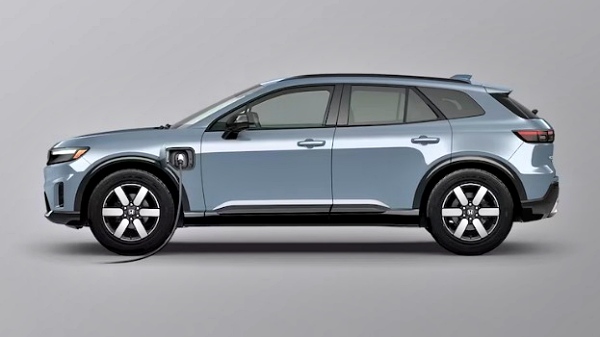
[Digital Today reporter Jinju Hong (홍진주)] Honda has officially confirmed it will end production of the Prologue, the last pure electric vehicle it has sold in the U.S. market. As the U.S. EV market faces slowing growth and policy changes, major automakers continue to cut back their EV lineups.
On July 18 local time, IT media outlet TechCrunch reported that Honda said the Prologue had entered the process toward ending production. The decision is seen as an example showing not only Honda's EV strategy reset but also a broader trend of fewer EV models in the U.S. market.
The U.S. EV market has seen some recovery in sales this year, but growth remains limited. Data released by Kelley Blue Book and Cox Automotive showed U.S. EV sales in the second quarter totalled 247,226 vehicles, accounting for 5.8 percent of total new-car sales. Sales rose from the previous quarter but fell from the same period a year earlier. The slowdown in demand is attributed to the end of a $7,500 federal EV tax credit in the fall of 2025.
Honda halted development of the Honda O Sedan and O SUV, and the Acura RDX electric vehicle as it reviewed its U.S. market strategy in March. At the time, the company cited U.S. tariff policy and competition from Chinese companies as key factors. Plans to end Prologue production later became known, and the company officially confirmed the model's production has entered its final stage.
The Prologue was Honda's key EV sold in earnest in the U.S. market. Produced at the Ramos Arizpe plant in Mexico through a collaboration with General Motors, it shared a platform with the Chevrolet Blazer EV. About 33,000 units were sold in 2024 and about 39,000 in 2025, but sales were reported to have slowed sharply after the tax credit ended.
Afeela, an EV brand jointly established by Honda and Sony, has also scaled back its plans. In March, the two companies withdrew plans to develop 2 Afeela-brand EV models. The decision came about 2 weeks after Honda announced it would halt development of 3 EV models for the U.S. market. Production plans have also effectively been halted for the Honda O Series midsize SUV that had been slated for a North American launch.
Other automakers are showing similar moves. Hyundai Motor announced in March it would stop selling the Ioniq 6 in the U.S. market. The structure of exporting Korea-produced volumes to the United States was reported to have been affected, and it plans to continue selling the high-performance Ioniq 6 N. The Ioniq 5 and Ioniq 9, by contrast, are produced at a plant in Georgia in the United States.
Nissan cancelled production of the 2026 model-year Ariya for the U.S. market last year, and Polestar has effectively struggled to sell new vehicles after failing to obtain U.S. government approval due to regulations on China-linked vehicle technology. It said it would continue selling existing inventory of the Polestar 3 and Polestar 4 and maintain customer services.
Tesla also announced early this year it would end production of the Model S and Model X. The company set out a strategy to shift the focus of its business from electric sedans and SUVs to artificial intelligence, autonomous driving and humanoid robots. The Model S and X production line at its Fremont, California, plant was dismantled to secure space for Optimus robot production, and the last vehicles left the assembly line this spring.
Volkswagen decided to halt ID.4 production at its Chattanooga, Tennessee, plant and focus on producing key models such as the internal-combustion-based Atlas SUV. Volvo also plans to pull the EX30 and EX30 Cross Country from the U.S. market and instead focus on selling higher-end electric SUVs such as the EX60 and EX90.
In the U.S. market, EV lineups are being reshuffled as the end of the tax credit, tariffs, regulations on China-linked technology, changes in consumer preferences and company-specific priority adjustments overlap. But with new entrants such as the Rivian R2, the U.S. EV market appears to be entering a phase in which slowing growth and model reshuffles are happening at the same time.
 Jinju Hong
hongjj@d-today.co.kr
Jinju Hong
hongjj@d-today.co.kr