
As the European Union's mandate for a "digital battery passport" approaches next year, South Korea's battery supply chain is being put to the test. Large cell makers have response systems in place, but many small partner firms supplying materials lack IT systems and specialist staff to measure carbon emissions. With regulation effectively acting as a barrier to market entry, there are worries partners' competitiveness could be shaken.
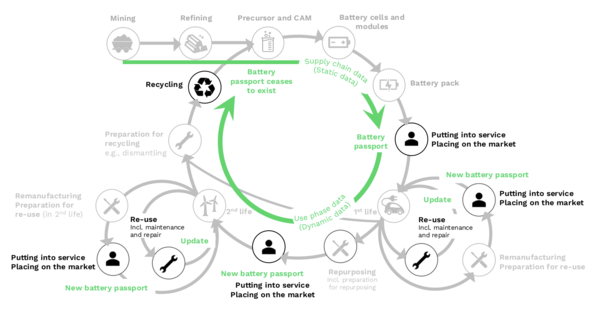
The battery passport is a system that assigns each battery a unique digital identity via a QR code and contains full lifecycle information from raw material mining through manufacturing, use and recycling. When consumers or companies scan the QR code, they can check the manufacturer and origin, carbon footprint, share of recycled raw materials and whether hazardous substances are included. The EU introduced the system for a circular economy and carbon neutrality by 2050. From 2027, electric vehicle (EV) and industrial batteries with storage capacity exceeding 2 kWh distributed within the EU must carry the passport. If it cannot be attached, batteries cannot be sold in the European market. The EU plans to expand the digital product passport (DPP) to products distributed across the bloc, starting with batteries.
The problem is that carbon emissions, a key piece of information included in the passport, cannot be completed using data from cell manufacturers alone. Most lifecycle assessment (LCA) data must be obtained from partner firms, and manufacturers are responsible for reporting it and for supply-chain due diligence. A passport can be completed only when process data from first-, second- and third-tier partners that make materials such as cathode and anode materials and copper foil are accurately documented.
EU think tank CEPS also said meeting the battery passport's goals depends on securing reliable data from each entity in the supply chain, and pointed to particularly strong concerns over whether upstream actors would accurately document and report carbon footprint data. LG Energy Solution said 64 percent of emissions occur before manufacturing and 36 percent in the manufacturing stage. That means a large share of emissions comes from raw material procurement and partner management.
Small partners lack data capabilities; concerns over a large-small gap
South Korea's three battery companies have responded in different ways. Samsung SDI signed a contract with data platform company Glassdome and built a system to calculate carbon data across the entire manufacturing process in line with the international standard ISO 14067. LG Energy Solution plans to develop and operate its own management system after unveiling a pilot for its battery passport system. SK On uses platforms from the group's information technology (IT) affiliates such as SK AX.
Industry assessments say that unlike large companies that have set up dedicated ESG teams over the past 2 to 3 years, small and medium-sized companies lack understanding of calculation methodologies, specialist staff and budgets. The National Cleaner Production Support Center under the Korea Institute of Industrial Technology said South Korea's export-dependent manufacturing sector is facing tighter environmental regulation, but small and mid-sized firms lack practical capabilities, from measuring carbon emissions to establishing response strategies and submitting data.
That is prompting criticism that individual companies, especially small firms, cannot handle vast supply-chain data on their own. The Korea Institute for Advancement of Technology (KIAT) stressed that corporate burdens should be lowered by building a national-level data-sharing platform and infrastructure. An industry official said, "A gap could widen between large companies that can afford to respond and small partner firms that cannot."
 Daegeon Seok
d2dg@d-today.co.kr
Daegeon Seok
d2dg@d-today.co.kr