
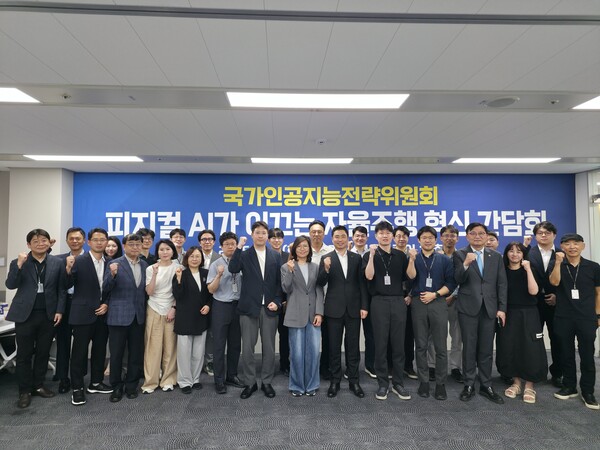
South Korea's National Artificial Intelligence Strategy Committee on Monday held a meeting on "self-driving innovation led by physical AI," led by the autonomous driving group under its Industrial AX and Ecosystem subcommittee.
The committee set up the autonomous driving group in April. The group consists of 12 industry and academic experts, including group leader Kim Soo-young (현대자동차), as well as HD Hyundai, Daedong AI Lab, HL Klemove, KAIST, Seoul National University and the TS Automobile Safety Research Institute. The group has discussed ways to secure domestic self-driving data, commercialise technology and build an ecosystem.
The meeting was organised to respond to a widening technology gap between global leaders in the United States and China and domestic companies.
Presenters at the meeting included Jwa Eun-hyuk (좌은혁), a professor at Seoul National University, Chae Sang-mi (채상미), a professor at Ewha Womans University, and Park Sun-young (박선영), head of the TS Automobile Safety Research Institute.
Jwa said domestic self-driving technology remains at the stage of test driving with safety personnel on board. The United States and China reached the stage of unmanned self-driving tests 10 years ago and 5 years ago, respectively. South Korea has fewer than 300 service vehicles, including those used in the Gwangju pilot project. Leading U.S. and Chinese companies operate more than 1,000 service vehicles. Jwa stressed that overhauling a strategic national roadmap is urgent.
Chae said competition in the self-driving market is shifting from model advancement to securing real city data. South Korea's accumulated self-driving data is less than 10 percent of that of leading countries. Chae suggested easing regulations and building data governance.
Park shared the progress of the "Gwangju autonomous driving testbed city pilot project". Park introduced the status of building a standardisation system for end-to-end (E2E) training data and a scale-up strategy. Park said government fiscal support and industry cooperation are needed to diversify testbed cities and increase the number of test vehicles.
In a subsequent panel discussion, participants stressed that building a government-led data-sharing platform and expanding testbed cities should be organically linked. They also agreed that expanding the government-level budget for autonomous driving is urgent.
Kim said, "Autonomous driving is the crystallisation of physical AI, where national AI capabilities are implemented in the real world," and added, "I will serve as a bridge so that opinions from industry, academia and research presented at the meeting are reflected in government policy." Cho Joon-hee (조준희), head of the Industrial AX and Ecosystem subcommittee, said, "Autonomous driving is a key pillar with the greatest ripple effect in building an AI ecosystem across industry," and added, "We will revitalise a convergence ecosystem across different industries to raise the competitiveness of South Korea's autonomous driving industry."
The committee plans to support the establishment of action plans related to autonomous driving and to underpin legal and institutional updates by relevant ministries and R&D investment. It also plans to continue playing a linking role for inter-ministerial cooperation, including building testbed infrastructure.
 Seul-gi Son
sageson@d-today.co.kr
Seul-gi Son
sageson@d-today.co.kr