
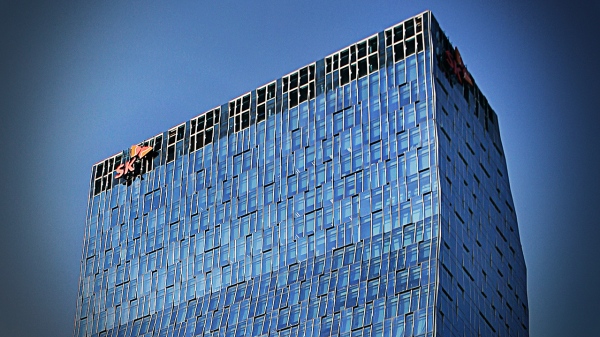
SK Telecom is pushing to build AI data centres nationwide with a capacity of up to 15 gigawatts, starting in Ulsan. It plans to bring 5 GW of domestic data centres online in phases from 2029 and expand total capacity to 15 GW by 2035, aiming to make South Korea an Asian hub for AI infrastructure.
SKT said on Saturday it is moving to build large-scale AI data centres to respond to rapidly rising demand for AI model training and inference and a situation in which high-performance computing infrastructure determines national competitiveness.
It plans to comprehensively review factors needed to build data centres, including power, location, operating systems and securing key customers, by linking the government's "AI top 3" strategy with tasks for balanced regional development.
From 2029, 5 GW to operate domestically; expanding to 15 GW by 2035
SKT will start with its first AI data centre now under construction in Ulsan and create an AI data centre cluster of more than 2 GW in the Yeongnam region. It will also build an additional 1-GW AI data centre in the southwest. Including these, it is pursuing a plan to secure a total of 5 GW of AI data centres in South Korea and bring them into operation in phases from 2029. It will then expand the project step by step, taking into account data centre demand and investment conditions, and push to build AI data centres with a capacity of up to 15 GW by 2035.
Building a 1-GW AI data centre typically requires about 70 trillion won in project costs, an estimate that reflects high-performance AI computing infrastructure and rising memory prices. SKT plans to raise funds through its own investment, strategic partners' investment, long-term contracts with client companies and project financing.
To reduce the initial investment burden and business risk, it will proceed in stages, reflecting actual demand and investment conditions. It also plans to discuss site selection, power supply and securing anchor tenants with the government, local authorities and industry. Anchor tenants are key customers that sign long-term contracts for a large share of a data centre's total capacity. They are cited as an important factor in securing stable profitability and investment funding for large-scale data centre projects.
"AI data centre supply shortage highlights Korea's investment appeal"
SKT explained that a global shortage of data centre supply is behind its decision to move ahead with large-scale AI data centres. Global consulting firm McKinsey & Company forecasts that while global data centre demand grows 19 to 22 percent annually, supply will not keep up, leading to a supply shortfall of about 15 GW in the United States alone by 2030.
Amazon has also announced a capital spending plan of about $200 billion this year, and global big tech companies are expanding data centre investment to secure AI computing resources quickly. Investment destinations that had been concentrated in the United States are also spreading around the world.
SKT noted that South Korea has competitiveness in key components for AI semiconductors such as high-bandwidth memory (HBM). It also presented as strengths power supply conditions based on nuclear power and liquefied natural gas (LNG), and large-scale infrastructure management capabilities accumulated from operating semiconductor production facilities. SKT believes that combining South Korea's industrial base with power and operational capabilities could allow the country to secure competitiveness as an investment destination for global big tech companies' AI data centres.
SK Group combines capabilities; SKT to lead design, construction and operations
SK Group affiliates' capabilities in semiconductors, energy, construction and data centre operations will be brought together for the project. Building AI data centres requires not only AI semiconductors and servers but also large-scale power supply, cooling systems, and construction and operational capabilities. SK Group plans to have affiliates with related capabilities participate in the project to build a full-stack AI infrastructure system.
SKT, as an "AI infrastructure architect", will oversee data centre design, construction and operations. It will also use its experience in AI infrastructure cooperation with global big tech companies such as Nvidia and Amazon Web Services (AWS). In Ulsan, it is currently building a hyperscale AI data centre with AWS, targeting operations in the second half of 2027. It is building cooling and power systems specialized for AI computing, reflecting AWS' technical requirements.
SKT plans to expand the Ulsan AI data centre to more than 1 GW over the long term. It recently also announced an operating plan with Nvidia for an "AI Factory", a next-generation AI data centre. It aims to start operating the AI Factory from 2027 and later grow it to gigawatt-class scale.
Linking with regional industries to become an "Asian AI infrastructure hub"
SKT plans to link AI data centres with regional industries to contribute to balanced regional development. In building data centres, it will consider regional power supply conditions, industrial bases and site availability, and review ways to link with related industries.
It said that building large-scale AI data centres is expected to become a basis for attracting global companies' AI infrastructure investment and supplying computing resources to domestic AI companies and research institutions.
SKT defined AI data centres as South Korea's third national innovation infrastructure, following the Gyeongbu Expressway in 1968 and broadband internet in 1998. Its goal is to secure an AI computing base of up to 15 GW and develop South Korea into an Asian centre for AI infrastructure.
Jae-heon Jeong (정재헌), SKT's chief executive officer, said, "This AI data centre construction is to proactively prepare the computing infrastructure needed by the global AI ecosystem." He added, "We will closely consult with the government, industry and local communities to contribute to South Korea's growth into a key AI infrastructure hub in Asia."
 Jin-ho Lee
jhlee26@d-today.co.kr
Jin-ho Lee
jhlee26@d-today.co.kr