
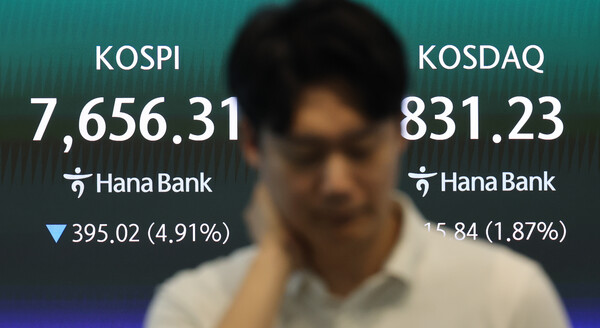
The KOSPI slid nearly 5% on the day Samsung Electronics released preliminary second-quarter results. Samsung Electronics posted results above market expectations, but selling poured into big semiconductor shares overall, triggering an intraday circuit breaker.
On July 7, the KOSPI closed at 7,656.31, down 395.02 points, or 4.91%, from the previous session. The index opened at 7,919.20, down 132.13 points, or 1.64%, and soon extended its losses.
At one point in the afternoon, it fell more than 8%, triggering a circuit breaker that temporarily halted trading on the main board.
In the main board market, individuals were net buyers of 3.1343 trillion won. Foreigners and institutions were net sellers of 2.9173 trillion won and 309.2 billion won, respectively.
Among the top market-cap stocks, semiconductor shares were weak. Samsung Electronics closed at 296,000 won, down 22,000 won, or 6.92%, from the previous session. SK Hynix fell 142,000 won, or 6.06%, to 2,201,000 won.
SK Square fell 9.30%, Samsung Electro-Mechanics fell 9.85%, Hyundai Motor fell 4.48%, LG Energy Solution fell 6.35%, Samsung Life fell 4.70% and Samsung C&T fell 5.56%.
Samsung Biologics rose 1.21%.
The KOSDAQ also weakened. It closed at 831.23, down 15.84 points, or 1.87%, from the previous session.
As of the market close, the won-dollar exchange rate stood at 1,527.30 won, down 3.20 won, or 0.21%, from the previous session.
The market sees index volatility as having increased as profit-taking after Samsung Electronics' earnings release combined with supply-demand pressure related to single-stock leveraged exchange-traded funds (ETFs).
Samsung Electronics reported operating profit above market expectations in its preliminary second-quarter results, but the move is seen as short-term selling emerging after it met raised expectations.
Han Ji-young (한지영), an analyst at Kiwoom Securities, said, "After Samsung Electronics' preliminary results, a view of it as a sell-on event was dominant in the short term, and single-stock leverage also acted as a supply-demand distortion factor that accelerated the stock price decline."
She added, "There is a need to refrain from interpreting the recent rise in volatility 그대로 as a trend-like decline in the index's direction," and said, "Given that it has already been pushed down to a level where a rebound can emerge on valuation, a strategy of maintaining existing stock weightings and positions is a better option than panic selling."
 Oh Sang-yup
yub@d-today.co.kr
Oh Sang-yup
yub@d-today.co.kr