
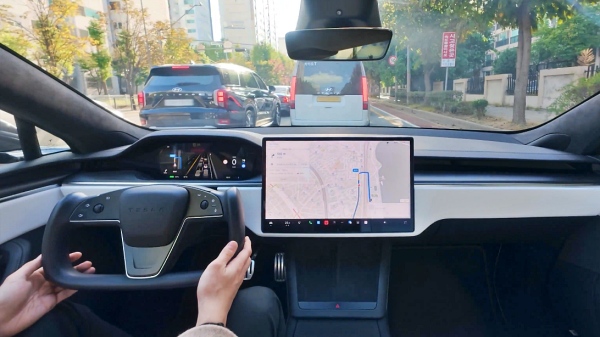
[DigitalToday intern reporter Seung-a Yoo] Tesla may introduce a feature that verifies a driver’s identity using the in-cabin camera before enabling Full Self-Driving (FSD).
Electrek, an electric-vehicle outlet, reported on July 6 (local time) that code in Tesla’s latest iOS application update includes signs of a process that checks whether the driver matches an authorised profile before deciding whether FSD can be used.
The signs were found while decompiling Tesla app version 4.58.5, built on June 27. The code includes strings related to identity-check failures, such as 'fsdIdentityCheckFailedTitle'. The in-cabin camera would verify the driver’s identity and, if it does not match a registered driver, block FSD and display a failure notice in the smartphone app.
It is not yet at a stage where it can be concluded as an officially released feature. Functions reflected in app code first can take weeks or months to be publicly released, and in some cases are ultimately not applied. Vehicle firmware updates would also be required for it to work. The feature is not complete with the app alone.
Tesla has expanded the use of the in-cabin camera over several years. The company activated in-cabin camera-based driver monitoring from 2021 and later expanded monitoring targets to include attentiveness, drowsiness, and eye and head position. From FSD v12.4 in 2024, the in-cabin camera above the rearview mirror became a core monitoring tool, judging attentiveness primarily by the driver’s face and eyes rather than steering wheel torque.
The feature spotted this time has a different role from existing attentiveness monitoring. If attentiveness monitoring checks whether a driver is looking at the road, identity verification is a step to determine whether the driver has the right to turn the system on in the first place. The change suggested by the code is closer to access control than to a safety warning.
A shift in how Tesla sells FSD is cited as a backdrop to why it is considering such a measure. FSD is now sold in a subscription format rather than as a one-time purchase. Tying access only to an account owner would make it easier to control paid features. For rental cars, shared vehicles and fleet operators, it could be a way to prevent unauthorised drivers or teenage drivers from arbitrarily turning on driver-assistance functions.
There is also a possibility of a link to robotaxi operations. Tesla has increased the role of in-cabin cameras in its plans for driverless operation, and a procedure to confirm that the person seated is the same as the actual caller aligns with functions needed for ride-hailing operations. If commercialised, a driver-verification feature could extend beyond access control for ordinary passenger cars into a robotaxi authentication system.
Hardware is a variable. Tesla’s in-cabin camera is a standard RGB sensor, not an infrared-based depth-mapping system like Apple’s Face ID. Because of this, there are observations that it could serve as an additional access-check tool but has limits as a strong biometric authentication lock. It also carries the same constraints as existing attentiveness monitoring.
Tesla’s vehicle manual acknowledges that the function may be disabled when lighting is poor or the camera is covered, or when the driver is wearing sunglasses or a hat. Even if an identity-verification feature is introduced, those conditions could also raise the possibility of malfunction or authentication failures.
Ultimately, what was confirmed this time is closer to direction than to a release announcement. The key point is that code-level signs show Tesla moving to tie FSD more strongly to an account-based service rather than treating it as a simple driver-assistance function. Whether the function will be implemented with future vehicle firmware, and how it would be applied in environments such as rental cars and robotaxis, will be points to watch.
https://t.co/2gdMVXNncs
 Seung-a Yoo
ysah@d-today.co.kr
Seung-a Yoo
ysah@d-today.co.kr