
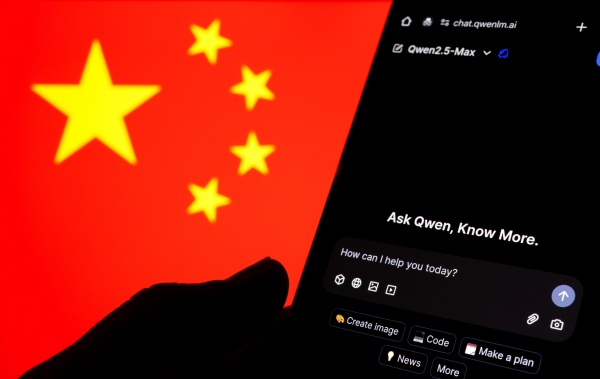
China's government has launched a sweeping overhaul of artificial intelligence services. It is raising oversight across the AI industry, including removing about 14,000 AI products from domestic networks for failing to meet safety standards and regulatory requirements.
On Sunday, blockchain media outlet Cryptopolitan reported that the Cyberspace Administration of China (CAC), the country's internet regulator, released the results of the first phase of its "Qinglang" campaign launched in April 2026.
In the crackdown, authorities removed about 14,000 AI-related services, including websites, mobile applications and AI agents, that failed to meet safety standards. They also deleted more than 6 million items of illegal or harmful information and suspended over 26,000 accounts. Authorities also deleted about 1,300 AI-related product listings and 9 open-source datasets they deemed illegal.
China's government also strengthened pre-registration and safety obligations for AI services. Going forward, AI services must apply robust safety filters and clearly label content as AI-generated. They must also meet standards for managing training data, and Chinese authorities warned that violations could lead to penalties including removal of services. A dedicated reporting channel has also been set up so general users can report AI misuse cases.
Major Chinese IT companies are also revamping services to meet regulations. Huawei strengthened separate review procedures for its app store, and Alibaba improved its AI content identification system. Zhipu AI built a new review model, while DeepSeek added verification procedures to prevent data manipulation.
Local governments are also building region-specific oversight systems. Beijing introduced a system that combines self-inspections by platforms with technical reviews, and Shanghai set rules by platform type. Zhejiang is focusing on AI model audits and training data security, and Jiangsu and Guangdong also built reporting systems and multi-agency cooperation frameworks.
China is moving straight into the second phase of enforcement. Regulators listed key targets including generating false information, producing violent or pornographic content, impersonation, infringement of minors' rights and AI-driven manipulation of public opinion. Penalties for violating companies and accounts will also be strengthened. Platform operators' responsibility for self-governance will also be applied more strictly.
From July 15, interim measures on managing "AI anthropomorphic interaction services" will also take effect. The rules target AI companion services aimed at forming ongoing emotional relationships. Under the new rules, AI companion services for minors are prohibited, and users under 14 need guardian consent. AI services must also include anti-addiction functions and an immediate termination function.
In response, ByteDance's Doubao and Alibaba's Qwen have moved to revamp services, including disabling some customized AI agent functions.
The move is also drawing attention because it comes as China continues AI technology competition with the United States. Chinese companies have been quickly catching up in recent months by releasing models with similar performance within months of the unveiling of the latest U.S. AI models.
Security firm Semgrep recently assessed that Zhipu AI's free model showed better performance than Anthropic's Claude Opus 4 in software vulnerability detection. Anthropic, meanwhile, has repeatedly raised concerns, alleging that some Chinese companies, including Alibaba's Qwen development team, distilled its AI models using fake accounts. It is known to have added a function to verify whether users are in China and then recently removed it.
China is overhauling its system in a way that maintains competitiveness in the AI industry while strengthening safety and protections for minors. The industry is watching how the second phase of enforcement and the new regulations will reshape the AI services ecosystem.
 Jinju Hong
hongjj@d-today.co.kr
Jinju Hong
hongjj@d-today.co.kr