
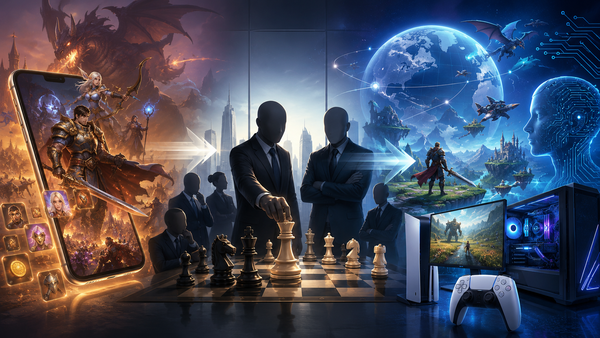
Major South Korean game companies revamped top management and key organisations in the first half of this year. The approaches differed, including CEO changes, the creation of a chair role and a change of publishing chief, but the direction was similar. They are moving to reduce reliance on a growth formula centred on mobile massively multiplayer online role-playing games and to shift business structures toward global markets, PC and console platforms, and in-house intellectual property. The core of the reshuffles was less about who became CEO and more about what capabilities were put at the forefront of management.
◆Nexon, Neowiz put development and global capabilities at the forefront
Nexon and Neowiz share a focus on placing development and global capabilities at the centre of management. Their methods differed. Nexon kept its existing management structure while appointing an external figure to a new role, while Neowiz promoted an internal developer directly to the top job.
Nexon appointed Embark Studios CEO Patrick Soderlund (패트릭 쇠더룬드) as its new group chair in February. It was the first time Nexon created a chair position. Patrick previously worked at Electronic Arts, DICE and Embark Studios and has a strong understanding of Western console and PC markets. While the existing management runs the group, he will focus on advising and overseeing next-generation development capabilities and global expansion strategy. Nexon has set up a separate axis for global development strategy above the CEO structure to broaden a revenue base weighted toward Asia into North America and Europe.
That direction also aligns with Nexon's business restructuring stance. Nexon is ending services for long-running online games such as "Bubble Fighter" and "Crazy Arcade". It is also reviewing its portfolio on profitability standards by winding down some projects and affiliates. It is focusing resources on expanding its key IPs, "MapleStory" and "Dungeon & Fighter", in the same context.
Neowiz took a more direct approach. It named Park Seong-jun (박성준), head of its New Titles Development Group, as CEO-designate and set up a co-CEO structure with CEO Bae Tae-geun (배태근). It is the first time since its founding that the company has put a developer in the CEO role. Park is a field expert who previously led Round8 Studio and has concurrently served as head of the New Titles Development Group since 2023. He led the development of "Lies of P". He will officially take office after approval at a regular board meeting in August.
Behind the move is a shift in business identity. Neowiz has grown mainly through external publishing, but after the global success of "Lies of P" it is pushing to become a PC and console game company with its own development IP. In mobile-focused businesses, post-launch operations and monetisation design were key to competitiveness, but in global PC and console markets, pre-launch completeness and genre competitiveness determine success. While Nexon bolstered global development capabilities through outside recruitment, Neowiz chose the same direction by directly granting management authority to an internal developer.
◆Krafton seeks an edge by specialising IP operations
Krafton took a different approach. Rather than changing its CEO or creating new positions, it pursued specialisation by replacing its head of global publishing.
Oh Jin-ho (오진호), chief global publishing officer, who led overseas business, stepped down and Jang Tae-seok (장태석), head of PUBG Studio, was appointed as his successor. Jang is an original member who took part in the early development of "Battlegrounds" from the Bluehole days, Krafton's predecessor. Since 2024, he has overseen PUBG IP franchise strategy and overall publishing. Krafton has effectively put the person who knows development sites best in charge of publishing.
The change is not simply a leadership replacement. For Krafton, which needs to prepare for what comes after "Battlegrounds", the ability to operate existing IP over the long term and advance it to fit regional markets has become important, along with finding new titles. It is read as a move to redefine the publishing organisation not as a simple sales channel but as a specialised organisation that operates IP franchises.
◆Kakao Games, Wemade begin with governance changes
Leadership changes at Kakao Games and Wemade began with governance changes rather than management strategy. Kakao Games changed management following an inflow of external capital, while Wemade is an ownership transition in which the founder is directly selling shares.
Kakao Games appointed Kim Tae-hwan (김태환), vice president of Line Games, and Lee Si-woo (이시우), Kakao Games' chief business officer, as co-CEOs on June 22 after an extraordinary shareholders meeting. The move followed an investment-purpose company funded by Line Yahoo, LAAA Investment, becoming the largest shareholder. Kim, who led M&A and strategic investments after working at Nexon and Line Games, will handle mid- to long-term strategy and global business development. Lee, who has led the publishing of major IPs such as "Odin: Valhalla Rising" since Kakao Games' early days, will oversee overall game business. As both come from business and strategy backgrounds, the appointments are seen as focused more on financial structure stabilisation and portfolio restructuring under the new largest-shareholder system than on putting developer leadership at the forefront. With the financial burden of operating losses for 6 consecutive quarters, the new leadership must demonstrate both new-title performance and profit improvement.
Wemade's case is closer to an ownership transition beyond a management reshuffle. On June 30, board chair Park Kwan-ho (박관호) signed a share purchase agreement to sell his entire stake to NeoPulse, a global investment platform. The total deal value is about 920 billion won, and the sale covers Park's 39.33 percent stake. The expected closing date was reported to be late October. The structure requires the final procedures and payment of the remaining balance to be completed, so the management system will not change immediately.
Park said in an internal message that the era of drawing the company's future based only on the Korean market has passed, and expansion into larger markets is not a choice but a condition for survival. He cited China and North America and Europe as core markets where the MIR IP is competitive. NeoPulse also pointed to Wemade's MMORPG development capabilities and the MIR IP's competitiveness in China as the background to its investment.
◆As the growth formula changes, CEO requirements change too
Leadership reshuffles across South Korea's game industry are taking different forms by company, but they point in the same direction. The moves fall into three tracks: strengthening development capabilities, specialising IP operations and restructuring governance, but all start from the same question of how to fill the gap left as the mobile MMORPG-led growth formula weakens. Including Wemade's ownership transition, the trend is spreading beyond management reassignments to a broader restructuring of governance across the game industry.
An industry official said, "The current reshuffles are not simple personnel moves or organisational cleanups but survival strategies." The official added, "With only operational capabilities proven in the mobile market, it is difficult to guarantee results in the global PC and console market. Putting the necessary capabilities at the forefront of management is an attempt to create a new decision-making structure to replace the existing growth formula." The official added, "If companies fail to deliver results in the global market within the next 2 to 3 years, the performance gap between top-tier companies and mid-tier game firms will widen further."
 Hojeong Lee
lhj@d-today.co.kr
Hojeong Lee
lhj@d-today.co.kr