
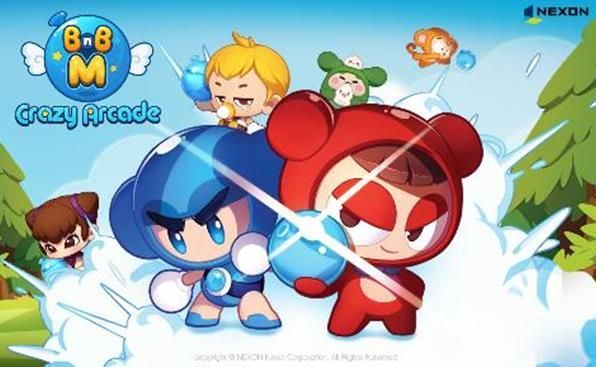
Nexon will end service for its 25-year-old long-running online game Crazy Arcade on Aug. 13 despite posting its best results since its founding last year. The decision appears to reflect a “profit floor” and a portfolio review stance presented by Patrick Soderlund (패트릭 쇠더룬드), head of Nexon’s Japan unit who took office in February, rather than poor overall company performance. The games industry reads the move as a signal that Nexon is redesigning its broader portfolio around profitability, not simply clearing out ageing titles.
◆ A chain of closures triggered by the “profit floor”
Soderlund said at a capital markets briefing in Tokyo in March, dubbed CMB 2026, that Nexon’s portfolio is too broad and that it would keep only projects that meet or exceed a newly set profit floor. He said Nexon had been too slow to make difficult decisions and that projects without business viability had pressured margins. He also laid out a plan to immediately redeploy staff and halt inefficient projects instead of carrying out large-scale layoffs.
After the declaration, the streamlining moved quickly. In April, Nexon announced the end of Bubble Fighter after 17 years of service and halted development of the new title Project EL. It fully transferred Tencent the operating rights for Dungeon & Fighter Mobile’s service in China. In its first-quarter earnings letter, Nexon additionally halted 3 projects that failed to meet quality and commercial standards. It also allocated resources more heavily to The Paradise: Last Paradise, which drew 37,000 concurrent users in early testing, and to Woochi the Wayfarer. The decision to end Crazy Arcade follows the same pattern.
The financial picture is paradoxical. Nexon posted record annual results last year, with revenue of 4.51 trillion won and operating profit of 1.18 trillion won. It also set new quarterly records in the first quarter this year for revenue, operating profit and net profit. As of year-end, cash and cash equivalents alone total 7.68 trillion won. By performance alone, it is not a situation that requires restructuring.
Even so, the reason Soderlund has rushed to overhaul the business model lies in the cost structure. According to Nexon Korea’s audit report, operating expenses rose by 457.0 billion won in a year, to 2.48 trillion won in 2025 from 2.03 trillion won in 2024. Outsourcing service costs increased 39 percent and labour costs rose 10 percent. Overall profitability improved as revenue growth exceeded the rise in costs, but the cost of maintaining services itself swelled by hundreds of billions of won. That structure makes it an increasingly weighty choice which games receive limited staff and budgets.
Redesigning the portfolio when results are strong leaves room to absorb short-term shocks. If restructuring begins after results weaken, it must deliver cost cuts and growth investment at the same time. Soderlund’s choice is interpreted as a pre-emptive judgement to cut first while there is still financial strength.
◆ Reworking the Crazy Park lineage… Crazy Arcade ends, KartRider is modernised
The end of Crazy Arcade is not just the closure of a single game. It is a turning point for Nexon’s entire casual game lineage.
Since its launch in 2001, Crazy Arcade helped lead South Korea’s PC bang culture with characters such as Dao and Bazzi. KartRider, released from the same universe as a racing title, expanded into esports, and the shooter Bubble Fighter surpassed 10,000,000 cumulative members. But the original KartRider ended in March 2023. KartRider: Drift, which sought to carry on the IP as a global multi-platform sequel, also shut down last October. Bubble Fighter ended on June 24. If Crazy Arcade also closes, the only Crazy Park-related game currently in service will be the mobile title KartRider Rush+.
There is another reason the closure draws more attention in the industry. A classic IP that Nexon itself had set as an “exception zone” is included. Nexon set up a “Classic Group” last year and has managed older IPs separately, including The Kingdom of the Winds, TalesWeaver, Legend of Darkness, Asgard and Crazy Arcade. Until now, these classic IPs were seen as an area that placed greater weight on symbolism and maintaining the user base than on short-term profitability. As Crazy Arcade leaves that exception, there is speculation that other classic IPs, where content updates have effectively stopped, could also become restructuring targets. Nexon’s position is that, for now, it has no additional plans to end service for other classic IPs.
Still, the Crazy Park IP is not coming to a complete end. Nexon on June 23 confirmed the official name of a development project based on the KartRider IP as Crazy Racing KartRider, the same as the original, signalling that it will bring back the Crazy Park IP in a modernised way. The new KartRider is being developed based on the original’s feel and core gameplay elements such as driving and control. Client modernisation work is also under way, including a redesigned lobby screen, a shift to 64-bit and adoption of DirectX 11. Nexon plans to share development updates regularly through its official website and communicate with users.
That shows Nexon’s portfolio reshaping is not simply a downsizing of long-running IPs. It is a shift toward removing an old live-service structure and reworking proven IPs to fit modern environments. Crazy Arcade and Bubble Fighter are ending service, while KartRider is effectively starting again with the feel of the original at the forefront.
◆ Cost cutting is the starting point… the key is reinvestment results in core IP
Kang Dae-hyun (강대현), co-chief executive of Nexon Korea, met reporters after a keynote at NDC 2026 and said that even if game services end, Nexon will ensure the IP can continue. For Crazy Arcade, he left open the possibility of continuing the IP through a user-generated content platform model, like MapleStory Worlds, where users create and share content. But he said it remains at the concept stage and specific plans have not yet been disclosed. Nexon is also pursuing a strategy of reallocating the resources freed up through such moves to core IPs and new global titles. It also plans to focus resources on projects that can deliver global results with fewer staff, like the development approach used by Embark Studios, which Soderlund founded.
The clean-up of long-running games, separate from cost efficiency, also brings issues of user trust. For users who have built up characters, records and paid assets over years, service termination can be seen as the loss of memories beyond a business decision. How Nexon continues the Crazy Arcade IP is expected to be the first test that will determine trust in how it operates classic IPs going forward.
An industry official said, “The core of the Soderlund system lies not in simple cost cuts but in how it reallocates staff and capital to projects.” The official said, “After Crazy Arcade ends, whether Nexon can continue the IP in some form and whether it can turn the modernisation of proven IPs, like KartRider, into results will determine the success or failure of its portfolio reshaping.”
 Hojeong Lee
lhj@d-today.co.kr
Hojeong Lee
lhj@d-today.co.kr