
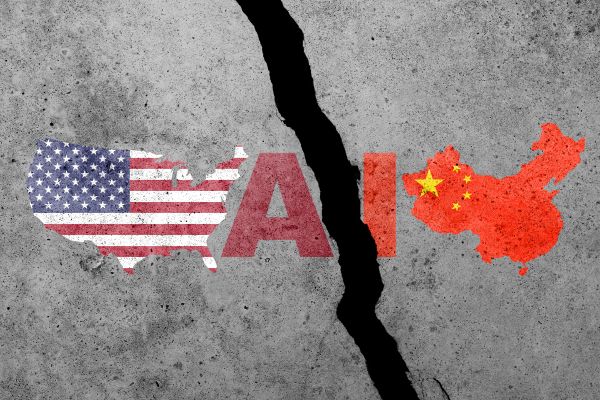
As the United States begins reviewing regulations on imports of China-made robots, the U.S.-China technology rivalry is expanding beyond semiconductors into robotics and physical artificial intelligence (AI). The United States is speeding up efforts to foster its domestic robot industry and reshape supply chains, while China is responding by wielding supplies of rare earths and magnets.
On June 24 local time, blockchain media outlet Cryptopolitan reported that U.S. Commerce Secretary Howard Lutnick said at a recent closed-door roundtable that he is reviewing the issue of robot imports backed by Chinese government support and could take necessary steps once the review is completed.
Lutnick compared it to an "upcoming arms race," saying the United States must avoid a situation in which robots backed by state subsidies attack the United States. The industry is raising the possibility that regulators could consider stronger measures beyond simple tariffs, including export restrictions, blacklists limiting transactions and investment controls.
Executives from major companies including SpaceX, Boston Dynamics, JPMorgan Chase, Goldman Sachs, Siemens and Rockwell Automation attended the meeting. Participants were reported to have focused discussions on reviving the U.S. manufacturing base and building supply chains inside the United States needed to produce next-generation robots.
Companies pointed to financing and permitting processes as the biggest obstacles during factory construction. The U.S. government is also moving to directly foster the domestic robot industry.
Signals of U.S. government support came first from the Pentagon rather than the Commerce Department. The U.S. Department of Defense Office of Strategic Capital was reported to be reviewing loan support for U.S. robotics startups Foundation Robotics and Standard Bots. Evan Beard (에번 비어드), co-founder and chief executive of Standard Bots, said the administration is trying to put real money to work and called it a key factor that enables manufacturing to return to the United States.
The Commerce Department already held a roundtable on U.S. robot supply chains in March, and on April 30 announced the launch of a formal investigation into the national security impact of China-made drones and robots. The closed-door meeting on June 22 is seen as a signal that the review has moved into a stage of openly indicating possible action.
China's response came the same day. China's Ministry of Commerce on June 22 added 10 U.S. companies, including U.S. rare earth firms MP Materials and USA Rare Earths, to a list subject to an export ban on dual-use items. The companies are leading players in rare earth refining and permanent magnet production in the United States.
Rare earth permanent magnets, especially neodymium-iron-boron magnets, are key components for robot actuators, electric motors and data centre cooling systems. The industry sees China's move as a pressure card that could raise cost burdens for the U.S. robot industry.
Markets reacted immediately. Shares of robot vacuum maker iRobot jumped more than 30 percent in a day, and robot-related stocks such as Richtech Robotics, Serve Robotics and WeRide also rose. Sherwood News said this showed the U.S. government going all-in on its domestic robot industry.
Moves to protect and foster domestic robot industries are also continuing outside the United States. South Korea's Trade Commission under the Ministry of Trade, Industry and Energy imposed anti-dumping tariffs of up to 19.85 percent this year on China-made industrial robots, and Japan set a plan to invest 10.5 trillion yen by 2040 across 17 key areas in physical AI.
The industry assesses that the U.S.-China competition for technological hegemony, once centred on semiconductors, is now expanding into robotics and physical AI. The United States is reviewing regulations on China-made finished robots while expanding financial support for domestic companies, and China is using rare earth supply chains as a strategic asset. The outcome of the Commerce Department's investigation, the level of actual regulation and whether the Pentagon provides funding are expected to emerge as key variables in reshaping the global robot supply chain.
 Jinju Hong
hongjj@d-today.co.kr
Jinju Hong
hongjj@d-today.co.kr