
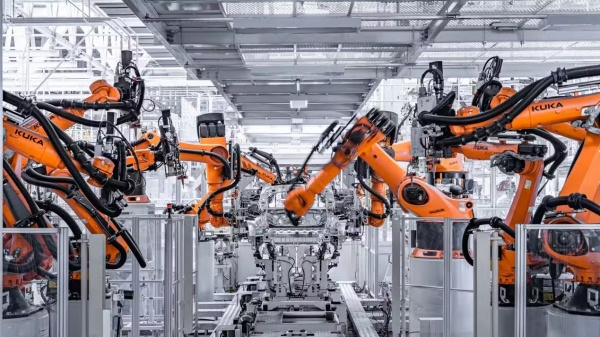
Nio’s F2 plant has been newly included in the World Economic Forum’s (WEF) Global Lighthouse Network of lighthouse factories.
Cleantechnica, an electric vehicle outlet, reported on Monday that the WEF recently announced the latest additions to the network and added Nio’s F2 plant as a lighthouse factory.
The Global Lighthouse Network is a manufacturing innovation certification system run by the WEF together with McKinsey. It selects factories that have delivered results by applying fourth industrial revolution technologies at scale on production sites. Because it is operated with independent screening and strict evaluation criteria, it has been used as an indicator of advanced manufacturing capabilities.
A key factor in the selection was Nio’s integrated production and development system. As competition in the electric vehicle market intensifies and faster product development, customised production and links between R&D and manufacturing and quality functions have grown in importance, Nio connected in-vehicle AI, its battery-swap network and a digital twin platform into a real-time closed-loop system. The WEF said the structure was designed to manage more than 3.6 million vehicle combinations.
The results were also presented in detail. Nio cut the time to product launch by 44 percent through the system and automated 90 percent of R&D work. The WEF pointed out that the electric vehicle industry is demanding faster product development, customisation and integration across R&D, manufacturing and quality, and assessed that Nio responded by building a real-time closed-loop system.
Nio’s F2 plant is operated as a fully digitalised smart factory. It uses industrial AI algorithms, foundation models and various specialised AI models that it continues to advance through in-house development. About 80 percent of production-site scenarios are supported by AI-based decision-making.
The selection also shows how far the smart manufacturing strategies of Chinese electric vehicle makers have advanced, beyond Nio’s manufacturing competitiveness. The Global Lighthouse Network places more emphasis on collaboration and connectivity across the value chain than on optimising individual processes. The WEF also said the network shows cases that link digital technology to next-generation productivity and value creation, and presents how manufacturing responds to efficiency, resilience and sustainability challenges.
Nio’s F2 plant has already been recognised as a national green factory by China’s Ministry of Industry and Information Technology and received the title of a super auto factory from the China Automotive Technology and Research Center. With the global lighthouse factory selection added, Nio’s production system has been recognised for both environmental performance and digital transformation results.
Nio has also sought differentiation in how it operates the plant. The F2 plant was built from the design stage with access for ordinary visitors in mind, and the company said it will open the plant so more people can directly experience and understand China’s intelligent manufacturing ecosystem. Since introducing factory tours in 2018, visitors to Nio’s two vehicle plants have reached about 300,000 worldwide.
Nio also set out plans to continue upgrading its advanced manufacturing system to meet the Global Lighthouse Network’s standards. The company said it will further strengthen the combination of AI and advanced manufacturing technologies to set a new benchmark for China’s smart manufacturing. The lighthouse factory selection again confirmed its strategy of growing the production system itself into a technological asset, beyond product competitiveness.
 Jinju Hong
hongjj@d-today.co.kr
Jinju Hong
hongjj@d-today.co.kr