
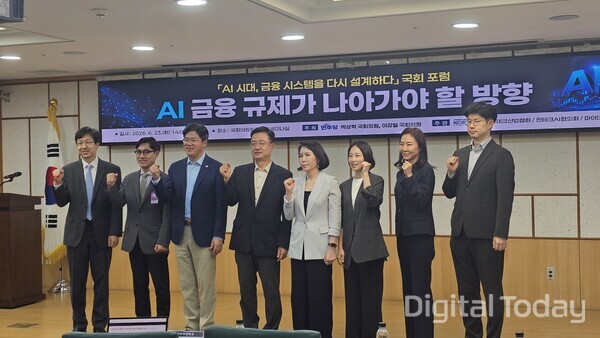
Use of artificial intelligence in the finance industry is spreading to credit scoring, abnormal transaction detection, financial counselling and wealth management, but network segregation rules and limited access to AI infrastructure are constraining innovation, criticism has emerged. Experts said as financial AI becomes core infrastructure, regulation should shift from pre-approval and permission toward continuous verification and accountability management.
At a forum titled "In the AI era, redesigning the financial system" held at the National Assembly Members' Office Building on June 23, Kim Jong-hyun (김종현), chairman of the Korea Fintech Industry Association, said, "AI is a key driver that raises the productivity and sophistication of financial services by a notch, and demand for AI use is rapidly spreading in the field." He added, "The core of the discussion on AI financial regulation must shift from whether to allow AI to how to raise the speed of innovation while managing risks."
The forum was jointly hosted by Democratic Party lawmakers Park Sang-hyuk and Lee Kang-il, and co-organised by the Korea Fintech Industry Association, the Fintech AI Council and the MyData AI Forum.
Lee Hye-min (이혜민), chairman of the Fintech AI Council and chief executive of Pinda, also said, "In the AI era, it is becoming more important how to design a new regulatory framework that can achieve innovation and trust at the same time." She stressed that it was "a meaningful change" that financial authorities are pushing to ease network segregation rules to expand use of external AI security solutions and software-as-a-service.
◆Financial AI: continuous verification, not 'permission', is key
Chae Sang-mi (채상미), a professor at Ewha Womans University business school who delivered a presentation, said the key to financial AI policy is not whether to allow adoption of AI. She stressed the need to establish a system that can identify and verify AI risks and quickly apply it across the industry.
Chae said financial AI is no longer an add-on function but is becoming core infrastructure of the financial system. She said if AI is used across financial decisions such as credit scoring, insurance pricing, payments and security, errors in individual services could expand into issues involving financial consumers' rights, the soundness of financial companies and trust in the financial system.
She said it is difficult to respond to AI risks with supervision centred only on prior notification, approval and permission. With AI models continuously upgraded and agent AI able to autonomously make decisions and execute actions, a supervisory system based on continuous verification is needed, she said.
Chae said South Korea has policy foundations, including the Basic Act on AI, AI guidelines for the financial sector, improvements to network segregation and special cases for innovative financial services. The task, she said, is to connect these systems into a single system and make it operate in practice.
She presented supplementary tasks including standardising an inventory of AI use cases by financial company and criteria to assess importance, creating audit standards for model and data lineage and change history and operating logs, managing supply chains for external AI models, cloud and data, resolving legal uncertainty to share signals for deepfakes and voice phishing, and setting criteria to allocate responsibility for agent AI.
Chae suggested, "South Korea currently needs to expand the scope of financial AI policy to securing operational evidence, a joint defence system and supply chain supervision."
◆Fintech industry: limits to deregulation centred on large companies
A panel discussion also addressed institutional and infrastructure constraints faced by the fintech industry in the process of adopting financial AI. Lee said discussions on AI-related institutional improvements such as easing network segregation are proceeding centred on large financial companies, and argued that an environment is needed in which small and mid-sized fintech firms and big tech companies can also participate.
She said, "The reality is that when we talk about financial AI, not only small and mid-sized fintech firms but also big tech have not been able to participate sufficiently in recent AI-related institutional improvements such as easing network segregation." She added, "AI technology is not only for large financial companies, and in South Korea's industrial structure where small and medium-sized enterprises account for a large share, SME adoption and use of AI can be key to strengthening competitiveness."
She said even if it is difficult to ease regulation uniformly for all companies, a more proactive approach is needed for operators with actual security capabilities and accountability systems. She said electronic financial business operators and MyData operators already have security systems and governance comparable to financial institutions, and that the scope of targets should be expanded based on actual AI use levels and management capabilities rather than company size.
Restrictions on use of AI infrastructure were also cited as a major difficulty. Lee said even if AI technology is used through innovative financial services, limits in models and infrastructure provided domestically make it difficult to apply the latest AI models.
She said, "Some AI models currently remain at quite an old version level in the versions provided domestically." She added, "When new models are coming out every few days or every few weeks, there is difficulty in having to apply for innovative financial services with older versions and prepare customer services."
She also said, "In Japan, it is possible to use various latest models such as Microsoft and Anthropic's Claude, while domestically the models supported are limited even though there is actual demand for use in the financial sector." She added, "More companies should be able to use AI within controlled guidelines so that domestic adoption of AI technology and investment can be activated."
Kim Jae-won (김재원), chairman of the Korea Startup Forum and head of ELICE Group, said that to expand AI use in the finance sector, the issue of building AI infrastructure should be considered along with regulatory improvements. Kim said, "We have been providing AI cloud services for more than 4 years, but we have not been able to provide them to a single financial company yet due to network segregation issues and the like."
He said running AI models requires GPUs and data centre infrastructure, but there is a shortage of data centres in South Korea that can accommodate high-performance GPUs. He said the infrastructure issue of actually operating AI in the finance sector should be considered along with regulatory discussions.
He added that properly implementing AI security policy requires significant GPU costs and specialised personnel. He stressed that policy support and inter-ministerial coordination are needed so that small financial companies can use AI infrastructure.
◆Financial Services Commission: to overhaul network segregation and data rules, consider AI-only supervision
Jeong Seon-in (정선인), director of digital finance at the Financial Services Commission who attended the forum, said the finance industry is at a point where it must directly lead AI innovation. Jeong said, "As AI changes the framework of all industries, finance must go beyond supporting AI and directly lead AI innovation." She said the effects of adopting AI, including cost reductions, faster processing and upgraded services, will bring changes across the broader economy for people and companies.
Jeong also mentioned the potential to expand AI-based alternative credit scoring and wealth management services. She explained that AI-based alternative credit scoring can offer new opportunities to people who lack financial history and have found it difficult to cross existing financial thresholds, and that AI agent-based wealth management will make customised services, previously centred on high-net-worth individuals, available to more people.
She stressed that clear standards and supervisory capabilities are needed for responsible innovation. Jeong said, "As AI's impact on consumers grows, responsibilities and authority must be clearly defined." She added that management and supervisory capabilities should be strengthened to check AI-specific risks such as cyber risks in advance and prepare for risks that are difficult to predict.
She said, "The Financial Services Commission plans to urgently ease network segregation rules for security purposes, and to overhaul regulations related to data use." She stressed it will also examine whether the overall set of rules by industry sector fits an AI-based financial environment.
She added, "We will continue to supplement the seven AI principles contained in the financial sector AI guidelines in line with the changing environment." She said it will also consider AI-only supervisory measures to protect consumers from issues of AI reliability and responsibility.
 Ji-young Lee
ljy@d-today.co.kr
Ji-young Lee
ljy@d-today.co.kr