
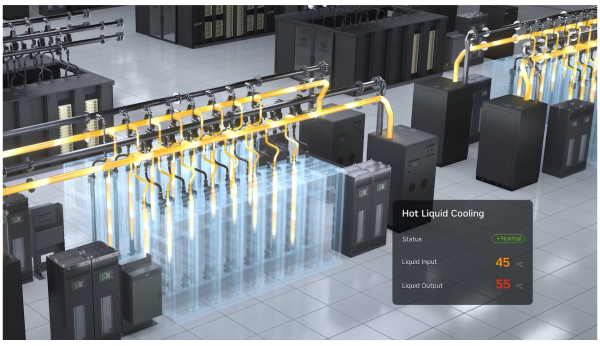
Nvidia has unveiled a new hot-water cooling system that could effectively eliminate water use inside data centres. Critics say cutting the overall water use of artificial intelligence (AI) infrastructure requires considering power generation and semiconductor manufacturing as well as the data centre itself.
IT outlet TechCrunch reported on June 22 that Nvidia introduced a hot-water-based closed-loop cooling system that can sharply reduce water use in data centres. The company said the technology can almost eliminate water use generated inside a data centre.
Josh Parker (조시 파커), Nvidia's chief sustainability officer (CSO), said in a press release, "Inside the data center, you can eliminate almost all water use." In a recent interview, he also said the data centre's water consumption problem was largely solved.
The core of the system is a closed-loop structure that circulates coolant for the life of the facility after a one-time fill. Coolant is supplied into server racks at about 45 degrees Celsius and exits at around 55 degrees after absorbing heat from servers. It is then cooled again through an external heat-dissipation unit and recirculated.
Because it does not require additional water supply, the process can effectively eliminate water consumption during data centre operations. Nvidia said on-site water use can be cut by 100% in regions with suitable climate conditions.
The system also has advantages in energy efficiency. Because it uses relatively high-temperature coolant, it enables passive cooling that releases heat using only outside air. It can also reduce the use of evaporative cooling equipment and large fans.
The problem is water consumption that occurs outside the data centre building. When water used in power generation and chip manufacturing is included, a facility's overall water footprint can grow by two to three times. In that case, the scope Nvidia's approach can reduce is limited to about one quarter to one third of an AI data centre's total water consumption.
The limit is clearer when a data centre's power source is fossil fuels. Data centres cannot operate without electricity, and many power plants are large water consumers. The U.S. Geological Survey (USGS) says U.S. fossil-fuel power plants consume 2.7 billion gallons of water per day. A recent study found natural gas generation consumes 1.17 litres of water per kilowatt hour (kWh) of electricity, while coal consumes 2.2 litres.
The International Energy Agency (IEA) has analysed that about half of data centre power is currently supplied by fossil-fuel generation. Hydropower also consumes more water than expected. Including reservoir evaporation, about 6.8 litres of water is estimated to be used to produce 1 kWh of electricity. By contrast, wind and solar use relatively little water, at about 0.01 litre and 0.03 litre, respectively.
Semiconductor manufacturing is also a variable. Producing AI chips requires ultrapure water and various manufacturing processes, requiring a substantial amount of water.
This structure may not change much in the future. The IEA expects natural gas and coal to account for more than 40% of newly needed power to meet data centre electricity demand by 2030. That means even if cooling technology inside data centres improves, the overall water footprint may not fall much unless the structures of power generation and semiconductor manufacturing change.
Experts therefore say that solving the AI industry's water-use problem requires not only innovation in cooling technology but also expanding renewable energy and improving efficiency in semiconductor manufacturing.
Nvidia's announcement is seen as meaningful progress in improving data centre operating efficiency. It also shows that a broader energy transition is needed to fully solve water consumption in the AI era.
 Jinju Hong
hongjj@d-today.co.kr
Jinju Hong
hongjj@d-today.co.kr