
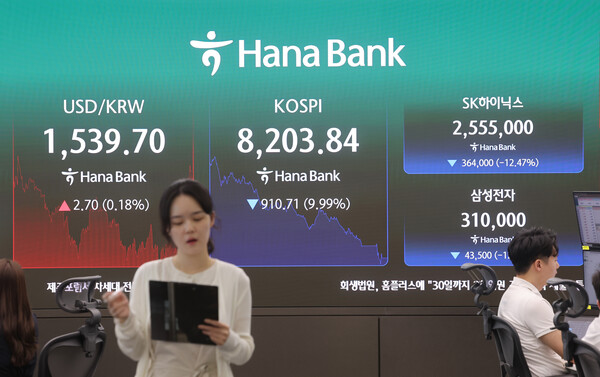
The KOSPI index plunged nearly 10 percent and slid to the 8,200 level. A sell-side sidecar was triggered in the KOSPI and Kosdaq in the morning, followed by a first-stage circuit breaker in the main board market in the afternoon, sharply dampening investor sentiment.
According to the Korea Exchange on June 23, the KOSPI closed at 8,203.84, down 910.71 points, or 9.99 percent, from the previous session. The index opened down 31.01 points, or 0.34 percent, at 9,083.54 and then tumbled as sell orders poured in.
In the main board market, retail investors were net buyers of 8.5847 trillion won. Foreigners and institutions were net sellers of 4.1256 trillion won and 4.5488 trillion won, respectively, dragging the index lower.
The Kosdaq closed down 76.88 points, or 7.94 percent, at 891.52. In contrast to the KOSPI, foreigners and institutions were net buyers of 258.8 billion won and 132.5 billion won, respectively, while retail investors were net sellers of 398.4 billion won.
Market stabilisation measures were triggered in succession across the two markets. A sell-side sidecar was triggered in the Kosdaq market at 11:37:50 a.m., and a sell-side sidecar was also triggered in the main board market at 11:40:44 a.m.
At 2:33:43 p.m., a first-stage circuit breaker was triggered in the main board market after the KOSPI stayed down more than 8 percent from the previous close for 1 minute.
Losses were steep among big semiconductor stocks. SK Hynix closed at 2,555,000 won, down 364,000 won, or 12.47 percent, from the previous session. Samsung Electronics fell 43,500 won, or 12.31 percent, to close at 310,000 won.
Other large-cap stocks also fell, including Samsung Electro-Mechanics, down 10.68 percent, Hyundai Motor, down 12.05 percent, and Samsung C&T, down 12.50 percent.
The won-dollar exchange rate also rose. As of the market close, the won stood at 1,540.80 per dollar, up 2.30 won, or 0.15 percent. The rise in the exchange rate and foreign selling pressure are seen as having increased downward pressure on the index.
Past cases in which the KOSPI fell more than 8 percent in a day were mostly linked to major negative events. Representative examples include the bursting of the IT bubble in 2000, the shock from the Sept. 11 attacks in 2001, the global financial crisis in 2008, the COVID-related liquidity panic in 2020 and concerns in 2024 over the unwinding of the yen carry trade.
Some in the securities industry also view this sharp drop as a correction driven by a combination of short-term overheating and supply-demand factors rather than damage to fundamentals. The KOSPI's 12-month expected operating profit growth rate stayed at a high level, boosting expectations, but concerns over earnings forecasts falling short and the growth rate passing its peak increased volatility, the analysis said.
Kim Seok-hwan (김석환), an analyst at Mirae Asset Securities, said, "There were concerns about semiconductor-led overheating and concentration, and we judge that technical correction pressure has increased rather than it being a fundamental issue." He added, "In particular, in terms of liquidity, short gamma has, to some extent, encouraged the leverage effect in rising or falling phases."
So far this year, sidecars in the KOSPI market have been triggered 27 times, exceeding the 26 triggers during the 2008 global financial crisis. As sharp swings in stocks continued, retail investors stepped in to buy the dip, net buying more than 8.6 trillion won intraday on a combined KRX and Nextrade (NXT) basis.
Still, as strong foreign and institutional selling persists, short-term volatility is likely to continue for the time being. The market points to whether supply and demand stabilise for large semiconductor stocks, the exchange rate trend and the intensity of foreign selling as key variables that will determine whether the market rebounds.
 Sangyeop Oh
yub@d-today.co.kr
Sangyeop Oh
yub@d-today.co.kr