
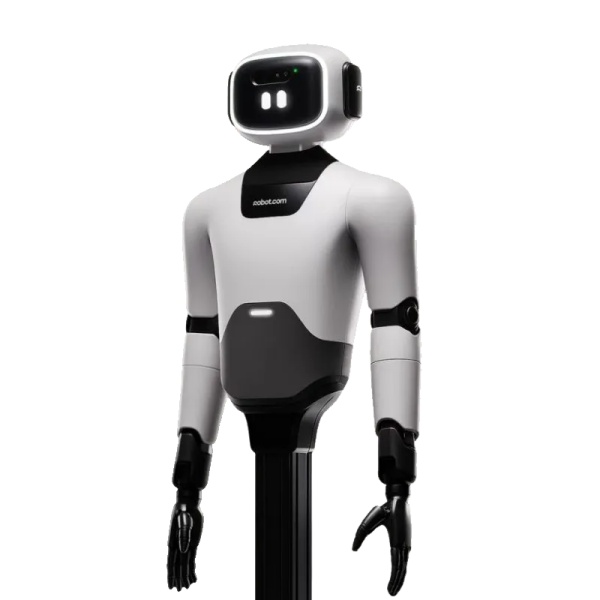
[Digital Today reporter Jinju Hong] U.S. startup Robot.com, known for delivery robots, is moving in earnest into the market for workplace humanoid robots. It is targeting the commercial labor automation market with wheeled humanoid robots that perform repetitive tasks at factories, logistics centers and restaurants.
Business Insider reported on Sunday that Robot.com said it plans to launch its workplace humanoid robot, the R-Noid, for customers in industry, food service and logistics. The R-Noid is designed to carry out repetitive, standardized work such as packing orders, loading and unloading boxes, preparing workbenches, picking, folding and guiding customers.
San Francisco-based Robot.com originally started as Kiwibot, a campus delivery robot company. It later changed its name and has expanded its business from delivery robots to commercial labor automation since about two years ago. Robot.com Chief Executive Felipe Chavez (펠리페 차베스) explained, "We are expanding beyond campus delivery robots into a variety of industries such as food service, logistics and healthcare."
The company stresses that it is a practical robot that can be deployed immediately in real workplaces rather than a general-purpose AI assistant or a household humanoid. Chavez said, "We are focusing on robots you can use today rather than robots of the future." Robot.com has currently deployed fewer than 40 R-Noids to about 12 customers.
Real-world operating examples are also emerging. At Harbor Links Golf Course in New York, the R-Noid loads food onto delivery robots and supports staff with order-packing work. The company plans to continue expanding the range of tasks the robots can perform.
It is also working to strengthen its AI capabilities. Robot.com is developing an AI model dedicated to the R-Noid in partnership with Physical Intelligence, a company that develops foundation models for robots. The model serves as core software that recognizes the work environment and decides actions.
The robot adoption process is also relatively fast. The company visits customer sites to analyze tasks that can be automated, then collects on-site data ranging from several hours to up to about 50 hours. It explained that it can then fine-tune the AI model and deploy the robot to actual workplaces within about 8 to 12 weeks.
Remote operation and remote support are also used in the initial stage. Chavez said autonomy is about 70 percent during the early deployment phase. The strategy is to deploy first at a level that can be operated in practice rather than full autonomy, then improve performance by accumulating data.
Robot.com argues that operating experience built through its delivery-robot business is a strength. The company said it has operated about 500 robots so far and cumulative task executions have surpassed 2.5 million. It also explained it already has systems for operations, maintenance, remote monitoring and service support.
In the humanoid market, a wheeled-robot strategy has recently been drawing attention. Diligent Robotics, which supplies robots for hospitals, as well as Sunday Robotics and Genesis AI have also introduced robots of a similar form.
The industry sees a strong possibility that the humanoid market will first grow around practical robots that perform specific tasks, rather than the long-term vision of humanlike robots.
Robot.com is also pursuing a strategy of using its existing delivery-robot customer base and operating experience to target automation demand in logistics, food service and service industries. The company said its long-term goal is to deliver labor-cost savings, but for now it is focused on helping companies adapt to environments where they work alongside robots.
 Jinju Hong
hongjj@d-today.co.kr
Jinju Hong
hongjj@d-today.co.kr