
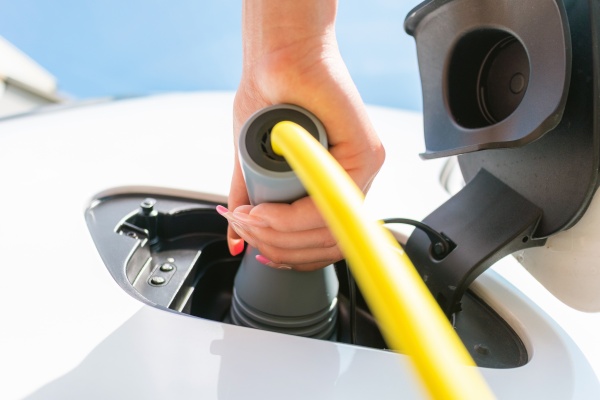
Goldman Sachs forecast that global oil demand could fall by up to 320,000 barrels per day by the end of 2027 as electric vehicles become more widespread. It judged that rising EV penetration led by China and growing fuel-cost burdens are bringing forward a slowdown in oil demand.
On June 22, blockchain outlet Cryptopolitan reported that Goldman Sachs presented two scenarios in a research note dated June 21.
In a "sustained acceleration" scenario, which assumes the pace of EV market share gains seen from February to May 2026 continues, it saw oil demand falling by 0.32 million barrels per day by December 2027. Even in a "temporary acceleration" scenario, in which regional EV adoption rates do not rise beyond May 2026 levels, it expected a 130,000 bpd decline over the same period.
China was cited as the key variable. China recently accounted for more than 60 percent of the increase in global EV market share. In May, EVs made up 26.1 percent of global new passenger-car sales. That was up 3.4 percentage points from three months earlier and the second-highest level on record.
Pressure on oil demand was not limited to passenger cars. Goldman Sachs analysts pointed to electric two-wheelers and three-wheelers in India, Vietnam and China accounting for most EV sales. They saw these vehicles cutting fuel use by about one-third to one-half of what is displaced by a single passenger EV, meaning the demand-reduction effect could be larger in regions with a higher share of two-wheelers.
Fuel-consumption indicators are also showing signs of weakness. Alexandra Paulus (알렉산드라 파울루스), a Goldman Sachs analyst, judged that high fuel prices stemming from supply disruptions near the Strait of Hormuz and the U.S.-Iran war were likely to have pushed consumers further toward EVs. She noted that in China, gasoline demand is weakening while EV charging volumes are rising.
China's retail gasoline sales in April fell by more than 20 percent from a year earlier. Reduced refinery runs and rising rail use also appeared. In Western Europe, retail sales volumes of automotive fuels fell by an average of 8 percent in the same month. Goldman Sachs said in a separate report earlier this month that oil demand on an actual retail basis is more sensitive to high prices and may have fallen more sharply than previously expected.
The demand pressure was also reflected in oil price forecasts. Goldman Sachs linked it to the possibility that Brent could fall to the mid-$50s a barrel by the end of 2027. For now, it sees the average Brent price in the fourth quarter of 2026 at $90 a barrel, but judged it could be about $10 a barrel lower if weak demand in China and Europe persists.
Structural changes across the broader market are also continuing. Twelve of the world's 15 largest EV markets recorded rising adoption rates between February and May 2026. The International Energy Agency (IEA) sees EVs accounting for half of global new car sales by 2035 even without additional government support. Last year, one in four newly sold vehicles globally was an EV.
Goldman Sachs ultimately placed weight on the view that the spread of EVs is no longer limited to a change in car sales and is starting to shake oil demand and oil price outlooks. With China at the center of wider adoption, it said the oil market has entered a phase in which EV penetration and fuel price trends must be considered together.
 Jinju Hong
hongjj@d-today.co.kr
Jinju Hong
hongjj@d-today.co.kr