
The government is pushing a plan to shorten the settlement cycle for stock sale proceeds to T+1 from the current T+2. The aim is to bring forward payment from two days after a sale to one day after, reducing settlement risk and increasing market liquidity.
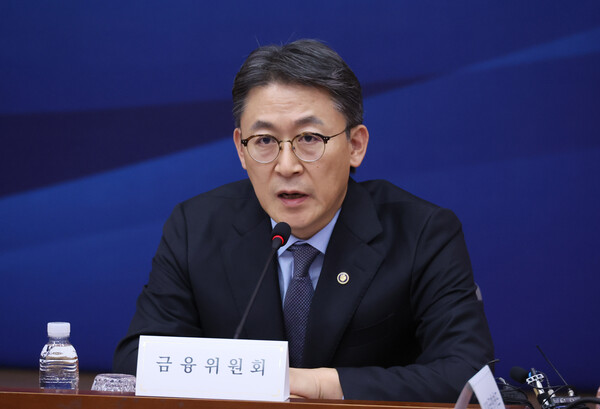
The Financial Services Commission said Vice Chairman Kwon Dae-young (권대영) held a "capital market infrastructure innovation review meeting" at the Government Complex Seoul on Monday and discussed measures to modernise trading and settlement system infrastructure.
South Korea's stock market currently operates on a T+2 basis, with settlement taking place two business days after the trade date. Investors have long pointed to inconvenience because they cannot recover sale proceeds immediately even after selling shares.
The push to shorten the stock settlement cycle drew renewed attention after President Lee Jae-myung (이재명) mentioned the need for institutional reform at a capital market meeting in March. The commission plans to prepare a detailed roadmap by October and disclose the direction for advancing the plan.
Kwon said, "Shortening the settlement cycle is a key reform task that can reduce risk between trading and settlement and improve market efficiency by freeing up liquidity that was tied up while waiting for settlement." He added, "We will prepare a detailed roadmap with October as the target to increase predictability in policy implementation."
Korea Securities Depository plans to build a pilot settlement infrastructure by the end of this year for unlisted shares and fractional investment over-the-counter trades, with settlement within T+1 day.
Financial authorities aim to first test settlement innovation in an environment independent of the existing clearing and settlement infrastructure. In the longer term, they aim to bring forward by one day the timing for receiving all stock sale proceeds.
A plan to extend trading hours is also being pursued. Korea Exchange plans to expand trading hours in stages by launching an after-market on Sept. 14 and introducing a pre-market by the end of next year.
With longer trading hours, investors' trading opportunities are expected to expand, while ensuring system stability at brokerages and the exchange is also expected to become more important.
The meeting also discussed measures to advance an artificial intelligence-based market surveillance system. The aim is to build a surveillance system that can effectively detect new forms of abnormal trading and signs of unfair trading as the capital market's digital transformation accelerates.
Kwon said, "In the past, markets that provided higher returns were competitive, but now how quickly and conveniently trading and settlement can be done and how diverse the assets that can be accessed are also important criteria for market choice."
The market sees the shorter settlement cycle and extended trading hours as potentially leading to improved competitiveness of South Korea's capital market. But because brokerage IT systems, settlement infrastructure and investor protection devices must be upgraded together, checks on preparedness among market participants are expected to be needed before implementation.
Meanwhile, President Lee also referred to the current settlement cycle, under which settling stock sale proceeds takes two days, at a cabinet meeting held at Cheong Wa Dae on Monday. He said, "From the standpoint of stock market participants, it may be hard to accept that after I sell shares it takes two days each time to get the money back."
He then instructed officials to "check whether it really has to be that way when they talk about the implementation timing as the second half of next year."
 Sangyeob Oh
yub@d-today.co.kr
Sangyeob Oh
yub@d-today.co.kr