
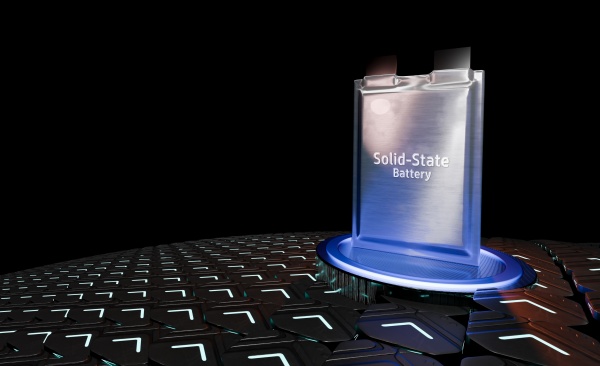
A Chinese research team has developed a new electrolyte system for all-solid-state batteries and reported that it maintained 84.15 percent of initial capacity after 350 charge-discharge cycles. The results are being assessed as a step toward addressing electrolyte stability and durability, key hurdles to commercialising all-solid-state batteries.
Electrek, an electric vehicle outlet, reported on Sunday that a team at the Chinese Academy of Sciences' Dalian Institute of Chemical Physics published results from research on all-solid-state batteries using a PVDF-based gel composite electrolyte.
All-solid-state batteries are a next-generation battery technology that uses solid electrolytes instead of liquid electrolytes. They are drawing attention as a core next-generation technology in the electric vehicle industry because they can offer higher energy density, faster charging and improved safety than conventional lithium-ion batteries.
But solid electrolytes face challenges in achieving efficient ion transport and good interfacial contact between electrodes. Sulfide-based solid electrolytes, in particular, have high conductivity, but their hard and brittle nature has created difficulties in the commercialisation process.
In this study, the team focused on the chemical reaction between lithium oxychloride (Li3OCl) and PVDF. The researchers said the reaction strengthened bonding between organic and inorganic materials, improving the stability and conductivity of pathways through which lithium ions move.
The experimental results were also positive. An NCA battery cell maintained 84.15 percent of its initial capacity after 350 charge-discharge cycles under 1C conditions. The team wrote in the paper that a new structure using a defluorination reaction strengthened interactions between the organic and inorganic phases and provided fast ion conductivity and a broad electrochemical stability window, adding that it could be a promising candidate for high-performance all-solid-state batteries.
Still, the results alone make it difficult to conclude that the study gives an edge in the race to commercialise all-solid-state batteries. Some leading companies, including Factorial Energy and QuantumScape, have previously disclosed results showing more than 95 percent capacity retention after more than 1,000 charge-discharge cycles. The study is meaningful progress in electrolyte design, but it remains short of industry-leading lifetime performance.
The study did not present specific figures related to energy density, driving range or charging speed. As a result, it is difficult to assess it as taking the lead in the commercialisation race, but it is being seen as meaningful progress in electrolyte design, a key challenge for all-solid-state batteries.
Competition in all-solid-state batteries has recently intensified. Chinese automakers are successively unveiling development plans for all-solid-state batteries capable of driving more than 1,000 km.
Changan Automobile is targeting driving more than 1,500 km under the CLTC standard with an all-solid-state battery with energy density of about 400 Wh/kg, and plans to begin test installation before the end of the third quarter of 2026. Chery also unveiled an all-solid-state battery capable of driving more than 1,500 km at its 'Battery Night' event in March, and Dongfeng Motor said it began testing an all-solid-state battery prototype in extremely cold conditions early this year. The battery presented energy density of 350 Wh/kg and driving performance of more than 1,000 km under the CLTC standard.
Development competition is also accelerating outside China. Stellantis and Factorial Energy recently began operating test vehicles equipped with all-solid-state batteries for the first time in North America, and Mercedes-Benz conducted a driving test of more than 1,200 km in September last year with an EQS-based test vehicle fitted with Factorial's all-solid-state battery. Mercedes-Benz technology chief Markus Schaefer (마르쿠스 셰퍼) said the technology could be a 'game changer' for electric vehicles. Honda and QuantumScape also announced a new partnership this week to develop and produce all-solid-state batteries for electric vehicles and other fields.
The industry is placing significance on the study as showing the possibility of solving materials problems that have hindered the commercialisation of all-solid-state batteries. Key points to watch will be whether the same performance can be delivered in a mass-production environment and whether energy density and charging speed can also be improved.
 Jinju Hong
hongjj@d-today.co.kr
Jinju Hong
hongjj@d-today.co.kr