
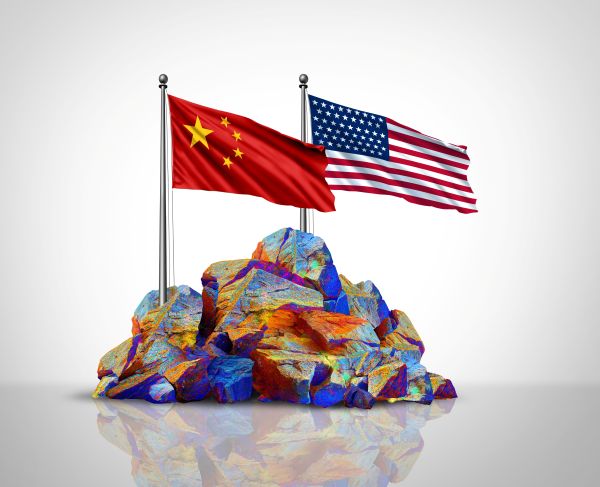
China has fully blocked exports of dual-use items to 10 companies, including U.S. rare earth firms, as the U.S.-China fight for technology dominance spreads to critical mineral supply chains. Concerns are growing that supplies of rare earths, essential to AI infrastructure and the semiconductor industry, could be affected.
On June 22 local time, the blockchain outlet Cryptopolitan reported that China’s Ministry of Commerce announced it had added 10 U.S. companies to its export control list and would ban exports of dual-use items.
The move is tougher than the existing licensing system. Chinese companies cannot export relevant items to the listed firms, and companies in third countries also cannot transfer Chinese dual-use items to them. The ministry said the step is aimed at protecting national security and national interests and fulfilling international non-proliferation obligations.
The key focus for markets is the rare earth supply chain. The targets include MP Materials and USA Rare Earths, among the largest rare earth companies in the United States. The two companies are regarded as key players in efforts to reduce reliance on China by expanding rare earth mining and refining and permanent magnet production capacity in the United States.
Rare earths are used to produce neodymium-based permanent magnets and are considered essential materials across advanced industries, including data centre servers, cooling systems, industrial robots, drones, electric motors and defence equipment. Their strategic importance is growing further as the spread of AI data centres lifts demand for server cooling facilities and automation equipment.
The problem is China’s overwhelming market dominance. China accounts for about 60 percent of global rare earth mining output, and its refining and processing capacity is said to approach 90 percent. With refining and magnet production seen as bigger bottlenecks than mining, analysis suggests it will not be easy for the United States to replace the supply chain in the short term.
The sanctions list includes drone makers Red Cat Holdings and Teal Drones, radar equipment company IMSAR, underwater robotics company Zyra Robotics, defence firm Oshkosh Defense and L3Harris Maritime Services, in addition to rare earth companies. These firms are closely tied to advanced technology industries such as AI, sensors, drones and autonomous systems.
China separately excluded products made by 46 U.S. companies from government procurement. The list includes Lockheed Martin and Raytheon Missile and Defense. U.S.-funded companies operating in China were excluded from the procurement restrictions.
The measures came after the United States recently added Alibaba, Baidu, BYD and Nio to a list of military-related companies. The market has interpreted China’s response as having the character of retaliation against U.S. technology sanctions on China.
The issue drawing market and industry attention is substitutability. The Center for Strategic and International Studies (CSIS) warned in an April report that China’s use of its own export control regime could put the world at risk of falling into an arms race of export controls and economic statecraft. Some analysts predict it could take up to 20 years to fully move the rare earth supply chain outside China.
The move is therefore seen as an example showing that, beyond semiconductors, rare earths and magnet-making capabilities have emerged as core strategic assets in the AI era.
 Jinju Hong
hongjj@d-today.co.kr
Jinju Hong
hongjj@d-today.co.kr