
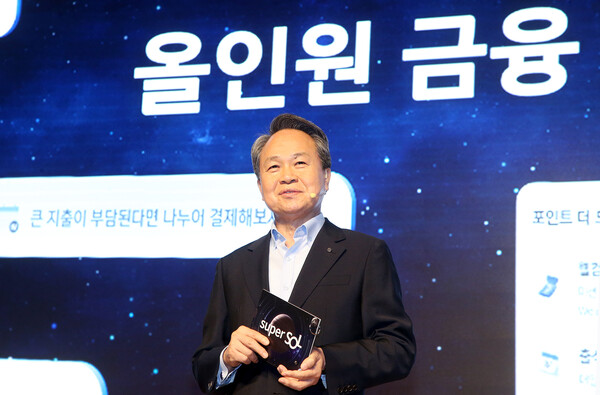
[DigitalToday reporter Ji-young Lee] Shinhan Financial Group unveiled Shinhan SuperSOL, an integrated financial platform that puts banking, card, securities and insurance services into a single app, reigniting the financial sector’s super app battle.
While existing integrated apps largely linked affiliate services, the overhaul is designed to let users handle key financial tasks in one place, centred on the banking app.
It also includes a strategy to expand bank customers into non-bank services such as securities by pushing Shinhan SOL LINK, which combines bank deposit and withdrawal accounts with stock trading.
Attention is on whether financial-sector apps will move beyond simply boosting installs to raising actual usage and transaction conversion rates.
• Shinhan Financial removes barriers among banking, card, securities and insurance in 'real super app' push • Shinhan Financial unveils integrated app Shinhan SuperSOL
AI use is expanding beyond simple customer-service chatbots into task processing and decision support. Agent-style AI linking internal document analysis, customer support and business automation has emerged as a new competitive front.
Anthropic also suggested that banks’ AI adoption standards should not stop at producing good answers and must shift to a structure that completes actual work.
As AI penetrates deeper into financial services, data reliability, security, accountability and the pace of regulatory updates remain core tasks for the sector.
• AI moves deeper into finance; can regulation keep up with innovation speed • Anthropic urges banks to adopt agent-style AI: 'work completion' over 'good answers' • Bank AI moves past the chatbot era with a full switch to 'connected intelligence'
This trend is also extending to on-the-ground applications by individual domestic financial firms and fintech companies.
KB Kookmin Bank ran a programme with Microsoft to strengthen employees’ AI capabilities. IBK Industrial Bank of Korea held an AI Day to select outstanding AI agent cases planned and implemented by employees, pushing internal innovation.
The finance sector’s AI shift is also expanding into talent development, with KB Kookmin Bank and Woori Financial running youth practical training programmes that include AI and data analysis and the use of AI agents.
Sh Bank introduced an AI-based ID copy verification system across all branches, and KB Real Estate rolled out a service in which AI comprehensively analyses prices, school districts, transport and development positives.
Data company Coocon is promoting an MCP-based data hub business so AI agents can use financial and public data, showing that AI competition is expanding beyond service adoption into competition over data-connection infrastructure.
• IBK Industrial Bank of Korea pushes work innovation with employee-built AI agents • KB Kookmin Bank holds AI expansion programme with Microsoft • Finance sector supports youth employment with AI finance practical training • Sh Bank introduces AI-based ID copy verification system • KB Real Estate offers AI analysis from prices to development positives • Coocon targets AI agent market with MCP-based data hub
Last week the KOSPI broke through 9,000 for the first time and rose as high as 9,300 intraday to extend its rally, but volatility also grew as it gave back gains amid uncertainty over U.S.-Iran negotiations.
Riding the stock market rise, net assets in domestic equity ETFs in South Korea’s ETF market reached 263.54 trillion won, exceeding half of total ETF net assets.
This week, the market is expected to gauge whether the semiconductor-led rally can continue by checking the U.S. May PCE price index and Micron earnings.
• Domestic equity ETF share tops 50 percent after KOSPI breaks 9,000 • [Stock outlook] Where the KOSPI goes after crossing 9,000; focus on PCE and Micron earnings • KOSPI ends slightly lower after topping 9,300 intraday • KOSPI breaks 9,000 for first time; 10,000 in sight • Mirae Asset Securities resolves to buy 300 billion won of treasury shares, its biggest ever
Along with the KOSPI rally, investors’ attention also spread to SpaceX, a U.S. mega IPO. SpaceX became the world’s fifth-largest company after surpassing Amazon with a market value of $2.66 trillion three days after listing on Nasdaq.
The successful listing also boosted the value of stakes held by early investors and key executives, creating “SpaceX billionaires”. But after its fast-track inclusion in the S&P 500 fell through, the next focus is shifting to the timing of its inclusion in major indexes such as the Nasdaq 100 and the resulting supply-demand changes.
South Korea’s financial investment industry, which faced controversy over failing to secure allocations of SpaceX shares, is set to be tested on its ability to respond to the next overseas IPOs such as OpenAI and Anthropic.
• Not only Elon Musk: billionaires who benefited from the SpaceX IPO • Jim Cramer: SpaceX valuation was made by Elon Musk, not earnings • Didn’t get SpaceX; what about OpenAI and Anthropic? Financial investment industry faces overseas IPO test • SpaceX surpasses Amazon three days after listing; $2.66 trillion market cap ranks fifth globally • SpaceX rejected for S&P 500 inclusion; likely Nasdaq 100 addition
Other major moves in finance and fintech were also compiled.
Banks moved to expand customer touchpoints by generation, including public institutions and university students. KB Kookmin Bank signed on as the main bank for the National Heritage Promotion Agency, supporting operating funds management and CMS 구축 for 5 years, while Shinhan Bank topped 10,000 ISIC international student ID card issuances.
Woori Bank applied WooriSAFE Settlement to the pharmaceutical distribution market to broaden its payments and settlement fund management area, and Hana Financial expanded touchpoints for senior finance and welfare consulting by using a park golf tournament venue.
Hana Bank teamed up with the Korea Certified Labor Attorneys Association to support small and medium-sized businesses and self-employed owners in drafting and filing retirement pension rules, showing a trend of bank services becoming more segmented into institutional finance, daily-life finance and pension management. Internet-only banks, with the era of 60 million users in sight, are stepping up competition focused on fundamentals.
• KB Kookmin Bank signs main bank agreement with National Heritage Promotion Agency • Shinhan Bank tops 10,000 issuances of ISIC international student ID cards • Woori Bank offers 'safe settlement' service to pharmaceutical distribution market • Hana Financial expands senior-care touchpoints through park golf • Hana Bank, labor attorneys association support SMEs' retirement pension rule filing • Internet-only banks near 60 million users; competition shifts from scale to substance
Kakao Pay unveiled June payment benefits tied to everyday merchants such as Musinsa, Twosome Place, convenience stores and Olive Young, moving to expand use of simple payments.
Toss Payments partnered with Webcash to develop a function that automatically links payment and settlement data to Gyeongrinara, expanding PG payment data into small business fund management.
• Kakao Pay unveils June payment benefits with Musinsa, Twosome and others • Toss Payments, Webcash push linkage of payment and settlement data
Loan brokerage and online investment-linked finance fintech companies moved to expand services while strengthening internal controls.
FinDA boosted its capabilities on financial consumer protection and regulatory response through compliance training for all employees, and Krpl launched a “second market” where online investment-linked finance investment rights can be traded.
Eight Percent is pushing linked investment with mutual finance institutions and moving to expand the supply of mid-interest-rate loans, showing the role of loan fintech expanding beyond brokerage into broader investment and supply-chain expansion.
• FinDA conducts compliance training for all employees • Krpl launches 'second market' for trading online investment-linked finance investment rights • Eight Percent pushes linked investment with mutual finance to expand mid-interest-rate loans
 Ji-young Lee
ljy@d-today.co.kr
Ji-young Lee
ljy@d-today.co.kr