
As the broadcasting industry’s financial crisis has come to the surface after general programming channel JTBC filed for corporate rehabilitation, criticism is growing that it is urgent to overhaul regulations for the paid TV industry, which faces a structural crisis due to falling subscribers and a deteriorating revenue base.
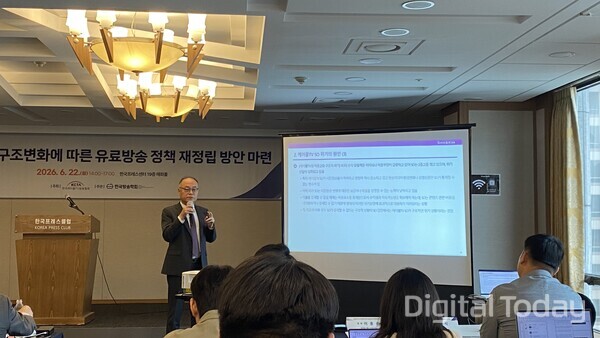
Lee Jong-gwan (이종관), a senior expert adviser at law firm Shin & Kim, urged a swift policy response at a seminar on “Preparing measures to re-establish paid TV policy amid structural changes in broadcast media” hosted by the Korea Cable TV Broadcasting Association on June 22. “If we miss the short-term policy timing, a second JTBC crisis could occur,” he said.
Lee said the most damaging long-term effect of the JTBC situation would be a contraction in investment in content production. He said if a mood of avoiding content production spreads in the market, content outflows from legacy platforms and a concentration of OTT subscribers would accelerate.
He also pointed to the lack of policy as a problem. He said there was no notable regulatory easing in the broadcast media industry while the market changed rapidly after the introduction of IPTV real-time services in 2009 and Netflix’s entry into the domestic market in 2016. He criticized the low policy attention, saying broadcast-related content was limited to a single line in VIP work report materials during the era of the Ministry of Science and ICT.
He also raised concerns that the JTBC issue could become a black hole and delay policy discussions related to paid TV, including cable TV, home shopping and program providers, at the Science, ICT, Broadcasting and Communications Committee in the second half. “Home shopping is urgent and PP are also struggling, and I worry constructive policy discussions on these areas could be delayed again,” he said.
He proposed designing policy directions divided into short-term and mid-to-long-term tracks. In the short term, he said easing the burden of the Broadcasting Development Fund and adjusting bargaining power over program fees were urgent. He cited a revenue-linked method, a basket method that sets a fee cap, and a fixed-rate system that locks in a certain percentage of revenue. Over the mid-to-long term, he stressed that the regulatory framework itself, designed on the premise of a growth phase since the introduction of cable TV in 1995, should be comprehensively reshaped to fit a mature and declining phase.
Concerns were also raised that, given the characteristics of paid TV as a licensed business, the issue could boil down to accountability for the Broadcasting Media Communications Commission, its supervising authority. Noh Chang-hee (노창희), head of the Digital Industry Policy Institute, said that if operators exit due to difficulties in their funding structure, the debate over the government’s role would inevitably emerge. He said policy changes, including re-establishing the identity of system operators and easing regulations, should be accelerated.
According to a profit and loss analysis of SO broadcasting businesses released by the Korea Cable TV Broadcasting Association that day, operating profit margins for SO broadcasting businesses on an accounting separation basis were minus 6.65 percent in 2022, minus 10.78 percent in 2023, minus 10.94 percent in 2024 and minus 7.04 percent in 2025. The sector posted losses for four straight years. Compared with the profitable range of plus 0.9 to plus 7.3 percent based on the Broadcasting Media Communications Commission’s disclosure standards for broadcasters’ financial status, gaps of up to 15 percentage points occur by year.
Over the same period, revenue from SO broadcasting businesses fell 8.9 percent over four years to 1.6 trillion won in 2025 from 1.75 trillion won in 2022, while the share of non-broadcasting revenue rose to 40.1 percent from 35.4 percent. The association forecast that if the current structure is maintained, SO broadcasting subscription fee revenue could shrink to as low as 348.5 billion won by 2030.
 Seul-gi Son
sageson@d-today.co.kr
Seul-gi Son
sageson@d-today.co.kr