
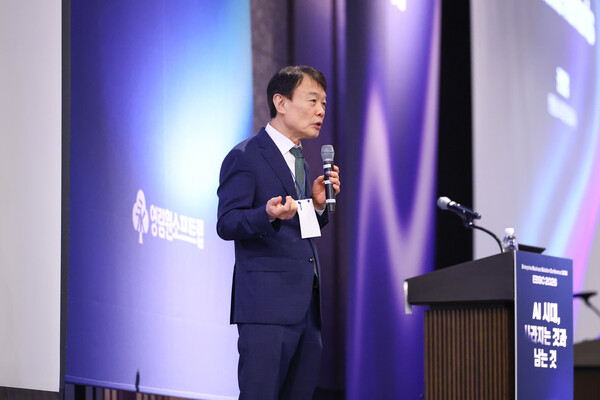
[DigitalToday reporter Chi-gyu Hwang] "No matter how much AI advances, companies will struggle to secure a competitive edge without experience and data accumulated directly by people in the field."
Young-bum Kwon (권영범), CEO of Younglimwon SoftLab, summed up corporate competitiveness in the AI era this way at the Enterprise Business Solution Conference 2026 (EBSC 2026) held on June 18. He also highlighted the growing role of ERP in AI strategy.
Kwon again stressed that development is accelerating sharply as the world shifts to an era in which AI develops AI. He said it is impossible for individual humans to have capabilities superior to AI in some areas. He said a structure is needed in which people directly meet customers, accumulate and share what they experience and feel as content in an era when AI works without sleeping.
He added that AI cannot exert its power without data. He said accumulating on-site experience built up by people within a company’s unique processes as content is key to finding corporate strategy and ways to secure a competitive edge.
According to him, the value of ERP is growing in accumulating on-site experience built up by people as content. He described ERP as core management infrastructure that helps integrate, accumulate and track cause-and-effect data across all stages of processes. He said the direction for pushing digital transformation should be a structure that puts overall process optimisation at the centre and links various solutions with ERP. He said completing digital transformation would make it possible to use AI at a strategic level.
Kwon also stressed the need for an AX strategy that fits an organisation’s purpose, citing examples that Younglimwon SoftLab is pursuing.
He said the company set out late last year to select 20 AI-based company-wide innovation tasks and created a forum for each organisation to present how it would use AI. He said plans initially poured out to apply AI in every area, and coordination was needed, using the organisation’s purpose as the standard. He said once they started by clarifying the purpose of the company and each organisation, the scope was set surprisingly easily. He said clearly sharing an organisation’s purpose is an important criterion for choosing not only AI but any new technology.
Younglimwon SoftLab also focused at the event on the message that the core of corporate competitiveness in the AI era lies in data, work processes and connectivity among systems rather than the functions of individual solutions.
In congratulatory remarks, Sung-jung Park (박성중), chairman of the Korea Productivity Center, stressed that productivity innovation in the AI era is not simply about adopting technology but about a qualitative shift based on data and AI. He also said corporate competitiveness in the AI era depends on how effectively companies accumulate, connect and use data, and that ERP will serve as the core foundation for such data use.
In a keynote speech, Hun-young Kwon (권헌영), a professor at Korea University’s Graduate School of Information Security, explained that in the flow of the industrial revolutions, the source of wealth has shifted from machines and energy and information to data, and assessed that corporate competitiveness in the AI era also stems from capabilities to secure and use data. He also said as data has become a new means of production, companies should focus not on introducing AI itself but on building a foundation to systematically manage and use data. Mi-kyung Park (박미경), CEO of Forcs, introduced cases of AI application in the electronic documents and e-contracts fields and presented a direction for automating the entire process of document writing, search and understanding using generative AI and AI agents.
Woong-ki Ho (호웅기), executive director of the Future Value Realisation Division at Younglimwon SoftLab, said the roles of function-centric software and the user interface are rapidly changing with the spread of generative AI and AI agents. He said in particular that it is becoming harder to differentiate simple function-centric SaaS (Software as a Service). He said competitiveness in enterprise software will depend not on individual functions but on work processes, data and connectivity among solutions.
 Chi-gyu Hwang
delight@d-today.co.kr
Chi-gyu Hwang
delight@d-today.co.kr