
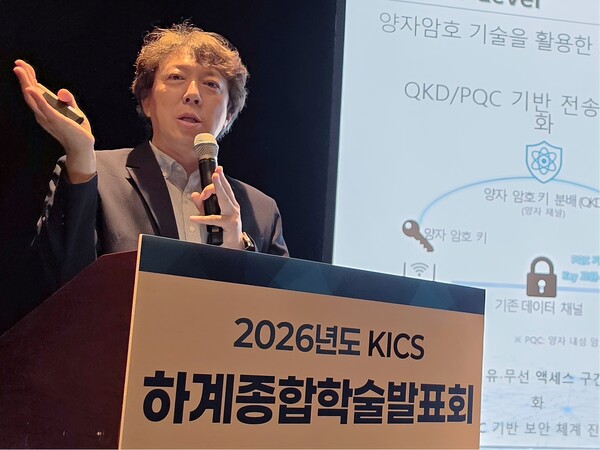
KT said on June 21 it unveiled its future network security blueprint, dubbed E2E Quantum Security, at a special session of the Korean Institute of Communications and Information Sciences’ summer conference, to respond to changes in AI and quantum technology environments.
The event was held from June 17 to 19 at the Haevichi Hotel & Resort in Jeju. Jae-min Jung (정제민), an executive director in charge of network AI research at KT, explained at the KT special session on June 19 that AI technology is being used for vulnerability detection and attack automation, and that autonomously evolving attack methods are changing the existing network security paradigm.
He stressed that advances in quantum computing could weaken the safety of existing public-key cryptography systems, and said the E2E Quantum Security strategy is aimed at responding to such threats.
According to the company, the E2E Quantum Security strategy is focused on applying quantum technology across key infrastructure, including not only data transmission paths but also network equipment, AI data centres and cloud.
It comprises 3 components: Quantum Link, which protects the data transmission section between customers and the telecommunications network; Quantum Node, which detects and protects vulnerabilities and anomalies in network equipment and operations; and Quantum Vault, which protects the entire data lifecycle from creation to storage, use and deletion.
Through this, KT projected it could build an integrated protection system across all areas, from transmission sections to network equipment and data, and strengthen the speed of response to cyber attacks and security safety.
Jong-sik Lee (이종식), head of KT’s Future Network Lab, said, "This special session was a meaningful opportunity to share AI-based security technology to respond to cyber attacks that are continuously becoming more sophisticated and KT’s future network security blueprint." He said, "KT will continue to strengthen the stability and reliability of future networks based on its AI and quantum technology capabilities."
 Chi-gyu Hwang
delight@d-today.co.kr
Chi-gyu Hwang
delight@d-today.co.kr