
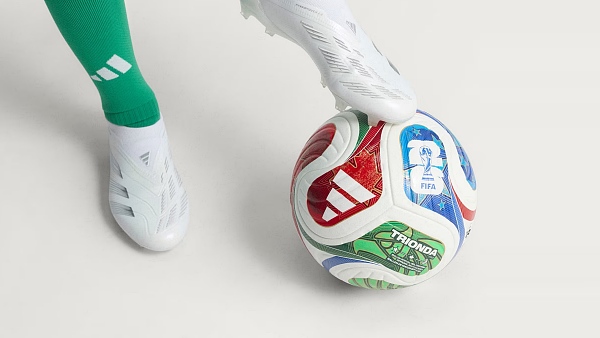
A paper verifying the aerodynamic characteristics of the 2026 FIFA World Cup official ball, Trionda (Trionda), through wind-tunnel tests by a joint South Korea-U.S.-Japan research team has been published in the international journal Applied Sciences.
Trionda is the official match ball for the tournament made by Adidas. Its name combines “Tri”, meaning the three-country co-hosting, and the Spanish word “Onda”, meaning stadium waves. The red, blue and green colours symbolise co-hosts Canada, the United States and Mexico, and it also features patterns of a maple leaf, a star and an eagle.
Trionda adopts the first four-panel structure in the history of World Cup official match balls. Fewer panels make the surface smoother, which directly affects trajectory stability. To compensate, Trionda applies deep seams, three raised grooves on each panel and fine surface processing.
The aerodynamic study of Trionda was carried out by a team consisting of John Eric Goff (존 에릭 고프) of the University of Puget Sound in the United States, Hong Seong-chan (홍성찬) of Seoul Women's University in South Korea, Richong Liu (리우 리촨) of the University of Tsukuba Graduate School in Japan, and Takeshi Asai (아사이 다케시) of Pacific Rim University.
The team tested Trionda at the University of Tsukuba wind-tunnel facility in Japan at wind speeds of 7 to 35 metres per second, and compared and analysed it with four previous official balls: Jabulani (2010), Brazuca (2014), Telstar 18 (2018) and Al Rihla (2022).
The wind-tunnel tests found that Trionda recorded a critical speed of 11.9 metres per second, or about 43 km per hour, in both orientations A and B. It was the lowest among the five balls. The critical speed of Al Rihla, Telstar 18 and Brazuca was in the 14 to 18 metres-per-second range, while Jabulani was the highest at 21.9 to 26.9 metres per second. Critical speed refers to the region where drag changes rapidly, and passing through this speed can greatly affect the ball’s trajectory, flight distance and acceleration.
A lower critical speed means the boundary layer transitions to turbulence earlier across match-related speed ranges. In corner-kick and free-kick speed ranges, Trionda’s drag coefficient stayed the most stable among past official balls. This contrasted with Jabulani, the 2010 official ball, which showed an unpredictable sharp drop trajectory on knuckle shots in the critical-speed range. However, Trionda’s drag coefficient value in the turbulent region itself was slightly higher than Brazuca, Telstar 18 and Al Rihla. Trajectory simulations showed Trionda’s flight distance was slightly shorter than past official balls across most speed ranges. The team explained in the paper that “players can feel that long kicks drop a few metres earlier than expected.”
A consistent correlation was also confirmed between seam shape and critical speed. Jabulani, which has narrow, shallow seams and the shortest total seam length at 1.98 metres, had the highest critical speed. Balls with wider and deeper seams tended to have lower critical speed. The team said, “The location of the sharp drag drop is determined by effective roughness created by the combined effects of seam width, depth and length and panel surface processing, and cannot be explained by a single value.”
However, the experiment focused on non-spinning balls. In actual matches, most kicks impart spin, and environmental variables such as temperature, humidity and atmospheric pressure also affect trajectories. The team added that future experiments on spinning balls and improved precision measurement techniques for surface roughness are needed.
Trionda also includes Connected Ball Technology. In the Sweden-Tunisia match at this tournament, when a goal by Mattias Svanberg (마티아스 스반베리) was hard to judge even with VAR footage, the technology was used to confirm whether Alexander Isak (알렉산데르 이사크) touched the ball, and it was recognised as a valid goal.
 Hyunwoo Choo
cookinpapa@d-today.co.kr
Hyunwoo Choo
cookinpapa@d-today.co.kr