
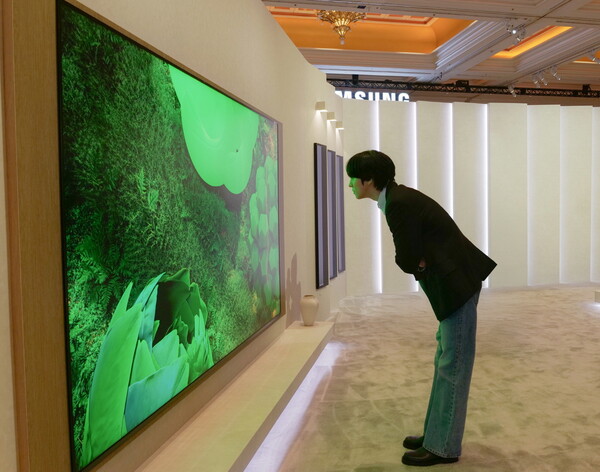
[Digital Today reporter Seok Dae-geon] Samsung Electronics put forward "AI daily companion" as a key phrase at CES 2026. Roh Tae-moon, head of the DX division, said at a press briefing in Las Vegas on Jan. 5 (local time) that the company would connect 400 million devices a year to become a "true AI daily companion." For its home appliances, it even gave the concept a name: "Home AI Companion." It envisions making the burden of housework "zero" and managing sleep and health as well.
AI has already settled in as a daily necessity. OpenAI said weekly active users of its AI app ChatGPT have topped 900 million. In South Korea, monthly active users reached 21.62 million, about half the population. That means half of smartphone users are using AI chatbots. A McKinsey survey also found 88 percent of global companies have adopted AI.
In this situation, what is needed for the word "companion," which Samsung stresses, not to remain a marketing phrase? A 2026 technology outlook 발표 last November by Amazon CTO Werner Vogels offers a clue to this question. Vogels said the relationship between technology and humans is fundamentally changing. He said a shift is under way from transactional device interactions to building relationships with physical AI.
Behind the focus on this change is the spread of loneliness. Vogels said 1 in 6 people worldwide experience loneliness, and the World Health Organization has designated it a public health crisis. He said 43 percent of adults aged 60 and older report loneliness, and social isolation increases the risk of death by up to 32 percent.
Vogels said that 10 years ago, forming meaningful emotional relationships with robots was science fiction, but that ageing demographics, advanced AI capabilities and the global spread of loneliness have created the conditions for a companion revolution. There is also clinical evidence. In a Paro robot study conducted at a long-term care facility in Canada, 95 percent of dementia patients showed positive interactions. Agitation, depression and loneliness decreased, and medication use and sleep patterns improved.
Another interesting point is Vogels’ explanation of why humans respond emotionally to machines. Vogels said humans are biologically designed to project intent and life onto objects that move autonomously. Citing research by MIT researcher Kate Darling, he said people treat robots like animals rather than devices. He also gave an example that 50 to 80 percent of Roomba owners give their vacuum cleaners names.
◆ Roh Tae-moon: "We will become a true AI companion with 400 million devices"
Samsung Electronics’ decision to present sleep and health management as goals of its "Home AI Companion" strategy also aligns with examples cited by Vogels. In particular, Samsung Electronics’ identification of robots and medical technology as four new growth engines matches Vogels’ predicted "conditions for a companion revolution created by ageing demographics, advanced AI capabilities and the global spread of loneliness."
Samsung Electronics’ approach, of course, differs from the companion robots analysed by Vogels. Rather than introducing robots, its strategy is to connect home appliances, TVs and mobile devices already in homes to create an "integrated AI experience." Roh said mobile devices are evolving into AI hubs, and TVs apply Vision AI to provide a personalised AI screen experience.
Even if Samsung Electronics’ approach is an ecosystem of devices rather than robots, the conditions for success are the same. Vogels said the key to AI companion success is "keeping people central to care while extending our capacity." Whether robots or home appliances, it means technology should not replace human caregivers but build a model of cooperation.
Samsung Electronics is also applying this human-centred philosophy from the design stage. Mauro Porcini, chief design officer, said at the Samsung Tech Forum held in Las Vegas on Jan. 7 that the company is applying the principle that "Form and function follow meaning" across design and plans to shift toward designing experiences rather than being product-centred.
Porcini said a people-centred approach is an obvious responsibility for the future and is an essential element strategically and economically, beyond being merely a matter of principle. He said emotions and identity must take root between technology and people through design to create a humane future.
◆ "People must be kept at the centre of care"
But a human-centred AI stance is not unconditionally positive. Vogels also left a warning. He said the deeper trust people form with companions, the more companies must implement strong control mechanisms so that they do not abuse that trust to influence users’ decisions or shape beliefs. He added that when developed responsibly, this shows technology at its best.
That is why AI ethics matter more for Samsung Electronics, which says it will connect 400 million devices across customers’ daily lives. Samsung Electronics has set its own AI ethics principles and has an AI safety framework. It set fairness, transparency and accountability as core principles in AI development and use.
Its goal is to create "human-centred devices" through preventing unfair bias, protecting personal information and operating an AI ethics council. It also sees AI safety as becoming more important as on-device AI functions expand, and has built an "AI Safety Framework" consisting of 2 core processes and 4 core components: data and model governance, and AI safety evaluation and red team operations.
 Seok Dae-geon
d2dg@d-today.co.kr
Seok Dae-geon
d2dg@d-today.co.kr