
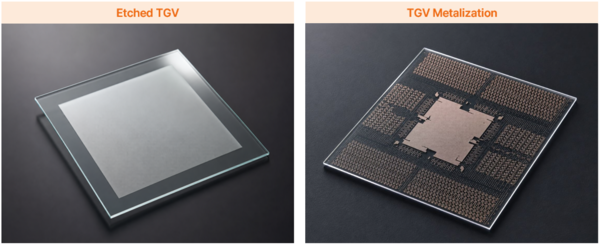
In the semiconductor packaging glass substrate market, JNTC is moving to expand its global supply chain by leveraging competitiveness in thickness. JNTC said on Thursday it developed the world’s first 2.0 mm thick TGV (through-glass via) glass substrate, a technology that drills microscopic holes in glass to pass electrical signals.
With the development, JNTC now has a full lineup of TGV glass substrates with glass thicknesses from 0.3 mm to 2.0 mm. The company said verification has already been completed by substrate makers in Taiwan and South Korea, while verification is currently under way with a Japan-based manufacturer. It has also already started development of a 3.0 mm thick product as the next item.
The 2.0 mm thick TGV glass substrate is considered a product with a high degree of manufacturing difficulty in the industry. That is because micro-cracks, or microscopic fractures, can easily occur inside the glass. JNTC explained it received a finding of no cracks in reliability tests by substrate manufacturers. A company official said, "We succeeded in realizing a customized product, and we have recently received proposals from some customers for a unit-cell cut processing step, and we have already secured the processing technology for this part as well."
After entering the TGV glass substrate business in 2024, JNTC is currently participating in new projects for 2 major global semiconductor companies. In 2025, it completed vertical integration of the entire production process by absorbing and merging its subsidiary Comet, which specializes in plating and etching processes, and in October of the same year it set up South Korea’s first mass production line for TGV.
Chief Executive Cho Nam-hyeok (조남혁) said, "The TGV glass substrate business is a major mid- to long-term new growth axis for JNTC, and with advanced technology, excellent quality and cost competitiveness, our company will come to stand in a very important position as a leading global advanced materials company in the AI-centered semiconductor-related market." The company has signed an MOU with a major South Korean company at the end of May, and is set to sign an additional contract in July with a Japan-based global substrate manufacturer.
 Seok Dae-geon
d2dg@d-today.co.kr
Seok Dae-geon
d2dg@d-today.co.kr