
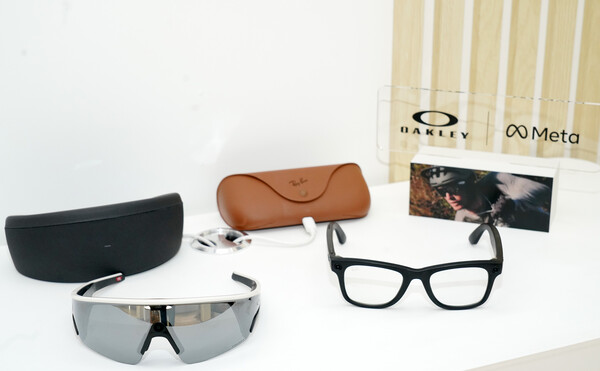
Smart glasses combined with artificial intelligence are drawing attention as next-generation wearable devices. Smart glasses that can take photos and videos, play music and answer natural-language questions have entered the South Korean market in earnest.
Meta officially launched the Ray-Ban Meta Gen 2 and Oakley Meta in South Korea on May 25. Ray-Ban Meta Gen 2 comes in 3 models: Wayfarer, Skyler and Headliner. Gen 2 carries over the design and key functions of its predecessor while strengthening camera and battery performance. Oakley Meta is available in 2 models: the sports-focused Vanguard and the HSTN with an everyday design.
A single phrase takes photos and videos, recording from a first-person view.
Ray-Ban Meta Gen 2 Skyler was borrowed from Meta for use. The most striking thing on first look was that it did not look like a smart device. It has a camera, speakers, a microphone and a battery, but its appearance was not much different from typical Ray-Ban sunglasses. Aside from slightly thick temples and a camera and a light-emitting diode on each end of the front, it looked closer to ordinary sunglasses.
The fit was more ordinary than expected. It was expected to feel somewhat heavy or for the temples to press on the head, but during a short wear it was hard to feel much difference from thick-rimmed glasses. It also did not feel unbalanced to one side.
How to use it is simple. The Meta AI app was installed on a smartphone and paired via Bluetooth. Pressing the button on the top of the right temple once takes a photo, and holding it starts video recording. The voice command function is especially convenient. Meta began supporting Korean after the official domestic release. Saying, "Hey Meta, take a photo" lets users take a photo hands-free. If told, "Hey Meta, record a video," it starts recording right away.
Users can issue commands as they normally speak without needing to find the button. It is useful when it is hard to take out a smartphone, such as when carrying bags, cooking, riding a bicycle or walking a pet. It is convenient when hands are tied up, such as while driving or operating complex equipment in a factory. It can also shoot quickly when an unexpected scene unfolds while walking.
The Ray-Ban Meta Gen 2 lineup has a 12-megapixel ultra-wide camera. The results differ in composition from photos taken with a smartphone. Because it shoots from the wearer’s eye level, it captures what the user is looking at from a first-person view. When shooting, the user hears a sound effect through the built-in open-ear speakers. At the same time, a white LED on the front right turns on so people nearby can see that recording is taking place.
Video can be shot at up to 60 frames per second at 1080p resolution and up to 30 frames per second at 3K resolution. The maximum length of a single video is 3 minutes. Video shot while walking reflects the user’s movement as is. Shifting the gaze slowly produces more natural footage, but sudden head turns or fast movement make the screen shake somewhat. To get good results, it is necessary to minimize movement, as when holding a camera in the hand.
Photos and videos can be imported to a smartphone through the Meta AI app. Imported content is also saved to the smartphone gallery. If users log in to the Meta AI app with Facebook or Instagram accounts, they can share directly to their social media.
Music and calls with a single pair of smart glasses, using open-ear speakers.
Another feature that improves convenience is the open-ear speakers. Users can listen to music and make phone calls through speakers built into the temples based on Bluetooth. Swiping the outside of the right temple forward or backward with a finger adjusts the volume. To play or pause music, users tap the touchpad. It was easier to understand surroundings because car sounds and voices of people nearby could be heard while listening to music. Still, because sound can leak due to the open design, it is better suited to walks or outdoor use than public transport or quiet public places.
It also serves as a daily helper using AI. With the device on, users can ask in everyday phrases such as, "Hey Meta, tell me today’s top news," or, "Hey Meta, what time is it," and hear answers through the open-ear speakers. AI functions linked to the camera, such as "Tell me the calories of the food I’m looking at right now," were also interesting. It can be used by looking at a tourist attraction and asking related information while traveling, or by asking for a menu to be interpreted at a restaurant.
Still, users need to keep in mind that the AI does not understand everything accurately. There were cases where it did not accurately grasp what the user was asking about when multiple objects entered the field of view at once.
Up to 8 hours of use, with privacy concerns a task to address.
Ray-Ban Meta Gen 2 can be used for up to 8 hours on a single charge in typical conditions. The device has 32GB of built-in storage. Actual use time can be shorter if music is played continuously or if video recording and AI functions are used frequently. Charging is done by placing it in a dedicated case, where it charges through contacts near the nose pads. About 20 minutes of charging can fill the battery up to 50 percent. It does not support charging by plugging a standard USB-C cable directly into the device. It can withstand slight sweat or moisture, but it is better to avoid wearing it in the rain.
The domestic launch price of Ray-Ban Meta Gen 2 starts at 690,000 won. Considering it has no display that shows information on the lens, the barrier to entry is not low. Even so, being able to record scenes in front of the eyes without taking out a smartphone, listen to music and ask AI questions is a clear strength.
Still, because it has a camera in a form similar to ordinary glasses, it made the wearer conscious of people around when filming. The LED signals recording, but it is possible the other person may not notice it right away. The convenience of recording daily life hands-free is appealing, but it is a product that requires user caution in considering others’ privacy.
 Jin-ho Lee
jhlee26@d-today.co.kr
Jin-ho Lee
jhlee26@d-today.co.kr