
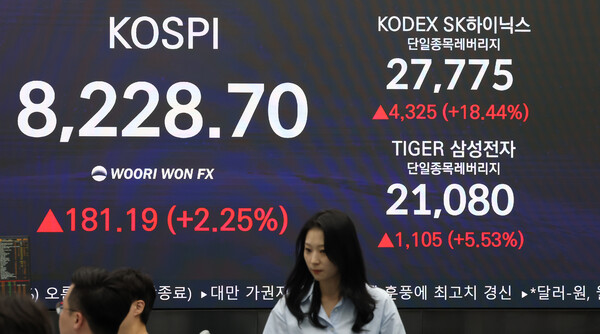
[DigitalToday reporter Ji-young Lee (이지영)] South Korea's Financial Supervisory Service has issued a consumer alert on single-stock leverage and inverse products. It judged that loss risks are growing as stock market volatility increases around semiconductor and artificial intelligence themes and retail investor money pours into related products.
The watchdog said on Wednesday it is issuing a "caution" consumer alert for investors in single-stock leverage and inverse products. Single-stock leverage products track the daily returns of individual stocks such as Samsung Electronics and SK Hynix by a set multiple.
According to the FSS, the market capitalisation of single-stock leverage products rose to 9.6 trillion won as of June 12 from 4.5 trillion won when they were listed on May 27. That was an increase of 5.1 trillion won in 12 trading days, more than doubling.
Over the same period, retail investors net bought 8.2 trillion won of single-stock leverage products. That accounted for 92.7 percent of total net buying. By contrast, institutions including liquidity providers (LPs) net sold 8.6 trillion won, while foreign investors' net selling totalled 200.0 billion won.
Trading is also showing signs of short-term dealing. Average daily turnover in single-stock leverage products was tallied at 8.6 trillion won, and the average daily turnover ratio was 122.5 percent. That was well above the less than 1 percent turnover ratio for Samsung Electronics and SK Hynix cash shares, and far exceeded the 30.2 percent turnover ratio for domestic stock leverage and inverse ETFs.
Price volatility was also large. From May 27 to June 12 during a consecutive decline, the maximum drawdown for single-stock leverage products averaged 36.9 percent. The underlying asset for Samsung Electronics fell 18.0 percent from June 4 to June 8, but the related leverage products' maximum drawdown was 35.9 percent. The underlying asset for SK Hynix fell 19.1 percent from June 2 to June 8, while related leverage products dropped 38.0 percent.
The FSS stressed that single-stock leverage products are not diversified investment products like ordinary ETFs. Because the products use one company as the underlying asset, issues such as weak corporate performance or a worsening industry outlook can be reflected directly in product prices.
In particular, if the underlying asset price moves against an investor's expectations, losses can be larger than in ordinary stocks or ordinary ETFs. Given the daily limit on domestic stock price moves of plus or minus 30 percent, losses could be as much as 60 percent in a single day, it said.
After the products were launched, on June 5, when SK Hynix shares posted their biggest drop, the stock fell 9.92 percent and the related single-stock leverage product fell about 20 percent.
The FSS also urged investors to be mindful of a "negative compounding effect". Because single-stock leverage products are managed based on daily returns, total returns over the investment period may not match twice the underlying asset's return over the same period. If the underlying asset price repeatedly rises and falls, actual performance may be lower than expected as gains and losses accumulate.
The divergence between market price and actual product value was also presented as a key risk factor. If investors rush in at once or there are not enough bid and ask quotes, the market price can form above net asset value (NAV). In that case, investors buy at a price higher than actual value, and losses can occur as the divergence normalises even if the underlying asset price does not fall.
The FSS said investors should also be cautious about market orders shortly after the open and near the close. Liquidity providers present bid and ask quotes, but they are exempt from the obligation to submit quotes for the first 5 minutes after the open and the last 10 minutes before the close. During those times, quotes may not form sufficiently and market orders may be filled at prices higher or lower than expected.
An FSS official said it will continue to monitor investment trends in single-stock leverage products. The official said it plans to take response measures, including issuing additional consumer alerts, if concerns about harm to financial consumers grow.
 Ji-young Lee
ljy@d-today.co.kr
Ji-young Lee
ljy@d-today.co.kr