
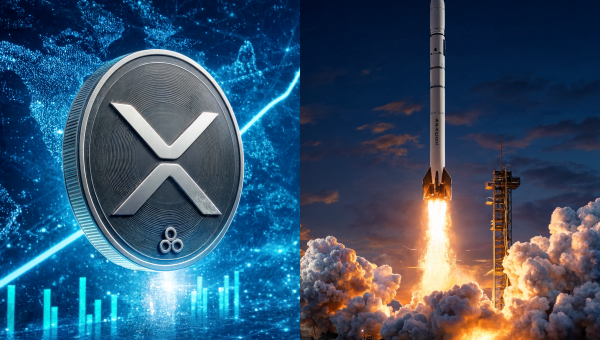
A claim has emerged that a scenario in which XRP reaches $10 and an investment grows by about nine times is more realistic than SpaceX posting the same level of return.
On June 16 local time, blockchain outlet The Crypto Basic reported that XRP YouTuber Jack Lector (잭 렉터) made the analysis by comparing the expected return potential of XRP and SpaceX.
Lector presented calculations in an X post and a YouTube video based on XRP’s price and market-cap structure. The figures he assumed were an XRP price of $1.13, a market value of about $77 billion and a circulating supply of about 62 billion tokens. Under those conditions, if XRP reaches $10, an investment would rise about 8.8 times and the market value at that price would be about $620 billion.
He said a market value above $600 billion could look large, but it is not an unattainable level given XRP’s goals targeting global payments and tokenised-asset markets. If the circulating supply rises in the long term to its maximum of 100 billion tokens, XRP at $10 would be worth about $1 trillion, which he also said is possible in the long term.
By contrast, SpaceX was valued at about $1.75 trillion at the time of its listing and later at one point topped $2 trillion in market value. Lector claimed SpaceX would need to grow to about $15 trillion to $16 trillion in value to deliver a roughly 9-times return similar to XRP.
He pointed out that this figure exceeds the combined value of the companies at the top of the global market-cap rankings. That would mean SpaceX would need to reach an unprecedented valuation to post a similar return. Lector added that the comparison was not intended to criticise SpaceX or Elon Musk, but to examine the possibility that the two assets could produce similar returns in the future.
Past growth cases in the cryptocurrency market were also cited. Lector mentioned that Bitcoin and Ethereum have precedents of growing into assets worth hundreds of billions of dollars. SpaceX, he said, would need to become a company several times larger than today’s biggest listed firms to generate the same scale of gains.
He also said that much of SpaceX’s large returns were first captured by early private investors and venture capital over about 20 years while the company was unlisted. Investors can still make profits after a listing, but his conclusion was that, over the next 3 to 5 years, XRP is more likely to deliver about a 9-times return.
Ultimately, Lector’s argument focused less on a forecast that XRP will necessarily reach $10 than on the large gap in the market size required when comparing on the same return multiple. He said XRP at $10 would need a value from the hundreds of billions of dollars to around $1 trillion, while SpaceX would require a valuation of at least about $15 trillion, making the difficulty different.
The comparison is seen as focusing on the scale required to produce the same return rather than the nature of the assets. XRP can see large price moves in a short period based on the cryptocurrency market’s high volatility and liquidity, while SpaceX, already recognised as having a large valuation, would need much larger capital inflows to rise by the same multiple. XRP’s outlook can also vary depending on market sentiment, the regulatory environment and the pace of expansion of the Ripple ecosystem, making it difficult to draw conclusions about investment appeal based only on a simple multiple comparison.
 Yoonseo Lee
yslee@d-today.co.kr
Yoonseo Lee
yslee@d-today.co.kr