
The government will 추진 “seven SEED projects” to foster future growth engines such as small modular reactors (SMRs), nuclear fusion, quantum, and space and aviation, following its three mega projects in semiconductors, physical AI and AI data centres.
The plan aims to secure advanced technologies in advance as next-generation growth drivers 10 to 20 years from now. It set goals by sector for securing technology and commercialisation around 2030 to 2035.
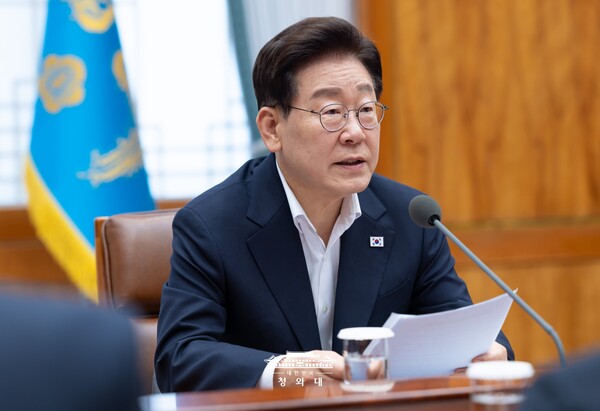
The Ministry of Science and ICT said on Tuesday it held a joint briefing with related ministries at Cheong Wa Dae on the “seven SEED future growth engine” plan and announced the 추진 approach.
SEED is an acronym for Strategic Emerging Engines for Disruptive innovation. It is meant to describe future growth engines that require strategic investment for disruptive innovation.
The government will 추진 the seven SEED projects in three areas: “future clean energy” including SMRs, nuclear fusion and next-generation renewable energy; “next-generation frontier” including quantum, space and aviation, and advanced bio; and “advanced supply chains” covering critical minerals and materials, parts, components and equipment.
SMRs, nuclear fusion, renewables... securing future power sources
In SMRs, it will begin detailed design jointly with the private sector from 2027, aiming to commercialise a light-water innovative SMR (i-SMR) in 2035. For non-light-water SMRs, it will push to establish a special purpose company (SPC) jointly funded by the public and private sectors from the early development stage, aiming to start construction in the 2030s.
For nuclear fusion, it will develop a Korean innovative fusion reactor with the goal of power generation in the late 2030s. It will build an “AI virtual fusion reactor” that uses AI to automate and optimise fusion reactor design and control, and push to build a demonstration reactor by 2035. It will also develop a commercial reactor in parallel for commercial power supply in the 2040s.
For renewable energy, it will develop perovskite tandem solar cells with efficiency of at least 35 percent and super-large wind turbines of at least 20 MW. The plan also includes localising water electrolysis systems and conducting large-scale demonstrations, localising high-voltage direct current transmission (HVDC) technology, and developing an AI-based power grid model.
Quantum, space, bio... aiming to secure technology leadership in the 2030s
In quantum, it will secure a domestically made 100-qubit-class quantum processor (QPU) capable of error correction by 2029. Under domestic companies’ leadership, it will develop a full-stack quantum computer covering quantum chips, control devices and operating software, and aims to rank first in the world in quantum chip manufacturing capability in 2035 through a “K-Quantum Foundry.”
In space and aviation, after launching a lunar-orbit communications satellite in 2029, it will launch a private sector-led 700 kg-class lunar lander in 2030 and a 1,800 kg-class lunar lander in 2032. It will also build an independent low-Earth-orbit satellite communications network by 2035. It will pursue technology development related to low-Earth-orbit space industries, including space data centres and active-control satellites.
In advanced bio, it will build AI-bio infrastructure by 2030, including cancer-specialised AI models, AI and robot-based autonomous laboratories, and bio foundries. It will develop brain-computer interface (BCI) products that use brain signals to input text or control machines, aiming for commercialisation in 2035.
10 trillion won in supply-chain R&D... building a whole-of-government 추진 system
In the advanced supply-chain area overseen by the Ministry of Trade, Industry and Energy, the focus is on internalising supply chains for critical minerals and materials, parts, components and equipment. It will expand the number of critical mineral stockpiling items from 24 to 29, and extend the maximum stockpiling period from 180 days to 365 days.
It will invest 10 trillion won in technology development for materials, parts, components and equipment by 2030. Within that, it will 추진 a “15 co-growth projects” programme worth 5 trillion won over five years. It will also seek to build a public-private cooperation system and dedicated funding to secure critical minerals.
To support the projects, the government will expand university basic research and block funding, and reorganise R&D systems at government-funded research institutes around national missions. For companies, it will push to introduce “investment-type R&D,” under which the government acquires stakes and reinvests funds later recovered.
It will also set up a whole-of-government 추진 system. It will form a public-private joint “future pioneering 추진 task force” led by the science and technology vice prime minister, and check detailed roadmaps and progress for each project through the ministerial meeting on science and technology.
The government plans to reinvest capital generated from the three mega projects currently under way into SEED areas, and build a virtuous cycle that develops grown SEED projects into new mega projects.
 Seulgi Son (손슬기)
sageson@d-today.co.kr
Seulgi Son (손슬기)
sageson@d-today.co.kr