
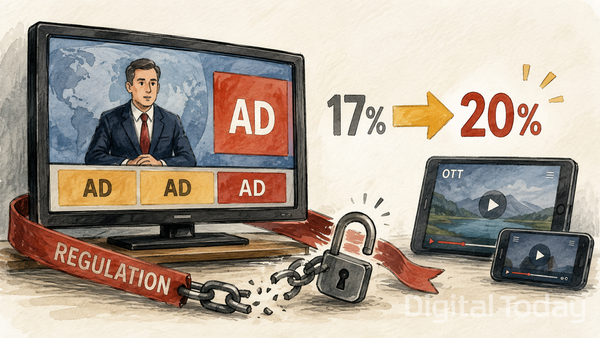
The total amount of advertising that can be scheduled in broadcast programmes will increase, and rules on mid-roll ads and virtual and indirect advertising will be eased. With the advertising market being reshaped around online platforms and online video services (OTT), the aim is to lift ad rules that have applied to broadcasting to expand broadcasters' autonomy in ad operations and their revenue base.
The Broadcasting Media Communication Commission on the 12th held a plenary meeting and passed a partial revision to the Enforcement Decree of the Broadcasting Act reflecting the changes. The decree is expected to be promulgated in early September after review by the Ministry of Government Legislation and vice-ministerial and Cabinet meetings, and to take effect in October, one month later.
The revision abolishes the 20 percent total ad-time cap applied to individual programmes and expands the daily total ad-time limit per channel to 20 percent from the current average of 17 percent of daily airtime. Broadcasters will be able to schedule ads more flexibly than before in programmes with strong ad demand.
To prevent ads from being concentrated in specific time slots, a separate 20 percent ad cap will apply during peak viewing hours, including weekdays from 7 p.m. to 11 p.m. and Saturdays, Sundays and public holidays from 6 p.m. to 11 p.m.
Rules on mid-roll ads will also be eased. The minimum programme length eligible for mid-roll ads will be shortened to 30 minutes from 45 minutes. The number of mid-roll ad breaks allowed by programme length will also increase, including to 2 from 1 for 45 to 60-minute programmes and to 3 from 2 for 60 to 90-minute programmes.
No per-programme ad ceiling... 50 billion won expected from mid-roll ads
Rules on virtual and indirect advertising will also be eased. The genres eligible for virtual ads will be expanded to include educational programmes, and the size limit for virtual and indirect ads on screen will be raised to no more than one-third from the current no more than one-quarter.
Size limits for subtitle ads and data-broadcast channel ads will also be eased to no more than one-third of the screen from no more than one-quarter. The duty to display a notification subtitle before mid-roll ads begins will be maintained, but the current size rule requiring at least one thirty-second of the screen will be abolished.
The easing comes as media use and the centre of the advertising market move quickly to digital media such as online platforms and OTT, while the broadcast advertising market has continued to shrink. The broadcasting industry has pointed to relatively strict ad rules for broadcasting, despite competing in the same advertising market, as putting it at a disadvantage against digital media.
According to the commission, terrestrial broadcast advertising revenue fell 56 percent to about 800 billion won in 2024 from about 1.9 trillion won in 2015.
The commission expects broadcasters will be able to respond more flexibly to ad demand as a result of the easing. It estimated that loosening mid-roll ad rules, which have high advertising effectiveness and contribute strongly to revenue, would increase broadcast advertising revenue by about 50 billion won.
During the legislative notice process, the broadcasting industry and civic groups differed over how far to ease rules. The Korea Broadcasters Association, the Korea Broadcasting Channel Promotion Association and SBS called for a full daily total system without a separate cap for peak viewing hours and for additional easing of mid-roll ad rules. Some civic and consumer groups, in contrast, raised concerns that ad concentration in certain time slots and an increase in mid-roll ads could infringe on viewing rights.
The commission kept the legislative notice plan, including a separate cap during peak viewing hours, citing the need to expand flexibility in ad scheduling while considering the risks of ad crowding and infringements on viewing rights. It also plans to strengthen monitoring of ad scheduling and viewer impact after the changes take effect.
Commission Chairman Jong-cheol Kim (김종철) said, "With this regulatory improvement, we expect to ease asymmetric regulation between media in response to changes in the media environment and to revitalise the broadcasting market," and urged broadcasters to work to improve content quality and protect viewing rights.
Pay TV welcomes easing... parity with digital remains a task
The pay-TV industry also responded positively to the direction of easing. It said expanding autonomy in ad operations is a necessary step as contraction in the broadcast advertising market and declining ad revenue are becoming a burden not only on broadcasters' management but also on content investment and the industry ecosystem overall.
An industry official said, "With the continued contraction of the broadcast advertising market and falling ad revenue becoming a burden on content investment and the entire industry ecosystem, this institutional improvement that raises autonomy in ad operations is a welcome measure."
The industry, however, sees limits to expecting reduced broadcast advertising funds to return to the broadcast market on the back of this easing alone. The centre of the advertising market has already shifted to digital media such as YouTube, online platforms and OTT, and advertisers choose media by considering reach and advertising effectiveness, among other factors.
The official said, "There are limits to expecting advertising funds to return to the broadcast market simply by easing some broadcast advertising regulations," adding, "Institutional improvements should continue not by stopping at lifting individual rules but toward ensuring regulatory parity between media so that broadcast advertising can compete on equal footing with digital media such as online platforms and OTT."
The commission also described the enforcement decree revision as a first step rather than the end of restructuring broadcast ad regulation and flagged additional easing. At the plenary meeting, some commissioners called for more forward-leaning reforms, including introducing a full daily total system and further easing rules on mid-roll ads and sponsorship.
Kim called the revision a provisional amendment. He said, "Today's revision of the enforcement decree is not the end of broadcast advertising innovation but a first step and a catalyst to break the outdated regulatory framework and inject vitality," and added, "In the second half of the year, please prepare a fundamental regulatory innovation plan covering the entire broadcast advertising ecosystem, including legislative matters."
 Seulgi Son (손슬기)
sageson@d-today.co.kr
Seulgi Son (손슬기)
sageson@d-today.co.kr