
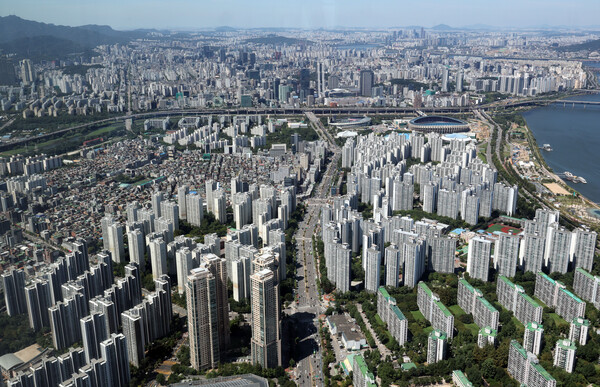
[DigitalToday reporter Ji-young Lee] The government will supply an additional 230,000-plus housing units in the Seoul capital region. It will sharply shorten the time needed to develop public housing sites and announce 100,000 homes in new public housing districts within the year. It will also speed up redevelopment and reconstruction projects and urban complex projects. The measures focus on reducing timing gaps in supply by expanding non-apartment supply and public sale and rental housing.
The government on Wednesday announced the measures under a plan titled "Rapid Housing Supply Measures to Stabilise the Jeonse, Monthly Rent and Sales Markets".
The additional supply effect in the capital region under the measures was estimated at 230,000-plus homes. Of that, additional starts in 2026 to 2030 are 120,000-plus homes compared with existing measures. The government plans to generate a supply effect of 160,000-plus homes by expanding supply from public sites, 14,000 to 24,000-plus homes through urban supply, and 59,000-plus homes by revitalising private-sector supply.
◆ Speed push on public sites... 100,000 homes to be announced within the year
First, the government will streamline procedures for developing public sites. For new public sites, it will cut the time from announcing candidate locations to starting construction to 37 months from 68 months. Depending on the size and characteristics of a site, it will also apply a separate model that allows construction to start within 21 to 34 months. For existing districts such as third-phase new towns and Seoripul, it will bring forward project stages by up to 1 to 2 years and start construction on 89,000 homes by 2030. Of those, 41,000 homes are volumes previously scheduled for after 2031 that will be moved to before 2030.
The government will also announce 100,000 homes in new public housing districts within the year. Locations disclosed this time total 27,000 homes: 1,000 homes in Yeomchang-dong, Gangseo district, Seoul; 21,700 homes around Wabu-eup, Namyangju, Gyeonggi; and 4,500 homes in Gyeonggi Gwangju Station Area 2 around Jangji-dong, Gwangju, Gyeonggi.
In Yeomchang-dong, Gangseo district, Seoul, the government will supply 1,000 homes by using the Yeomchang Park site, which has been left unused for a long time since a private development project was cancelled in 2006, and plans to start construction in 2029. In Wabu-eup, Namyangju, it will supply 21,700 homes in a greenbelt area near a Gyeongui-Jungang Line downtown station and push to start construction in the first half of 2030. In Gyeonggi Gwangju Station Area 2, it will supply 4,500 homes near Gyeonggi Gwangju Station on the Gyeonggang Line and also plans to start construction in the first half of 2030.
Candidate locations for the remaining 73,000-plus homes in new sites will be additionally announced within the year after consultations with relevant agencies.
Until the additional announcement, the government will temporarily designate all greenbelt areas in Seoul and parts of greenbelt areas in the capital region adjacent to Seoul as land transaction permit zones. Areas around the new sites in Namyangju and Gwangju disclosed this time will also be designated as land transaction permit zones for 5 years from the date of announcement.
Non-residential land left unused for long periods within public sites will also be converted into residential land. The government plans to convert 490,000 pyeong to residential land and start construction on 30,000 homes by 2030. Targets include third- and second-phase new towns and smaller sites, and it first disclosed conversion locations for 4,400 homes across three areas, including Incheon Geomdan, Siheung Geomo and Uiwang Wolam.
◆ Easing rules for redevelopment and urban renewal
The government will also expand urban supply. It will revise procedures and regulations so that about 234,000 homes from redevelopment and reconstruction in the capital region can begin construction as planned by 2030. The consent requirement for establishing a redevelopment association will be lowered to 70 percent from 75 percent, and the consent requirement for designating project implementers for public redevelopment and reconstruction will be eased to 60 percent from 67 percent. It will also simplify re-tendering procedures when only 1 bidder participates in a contractor bid.
For urban public housing complex projects, the government will select additional candidate sites in Seoul in the second half totaling 10,000 to 20,000 homes. Projects are under way at 47 locations with 85,000 homes, and the government is targeting construction starts for 51,000 homes by 2030. It will also expand support for small-scale maintenance projects to start construction on 4,200 additional homes by 2030 compared with existing plans.
New-build purchase-and-lease rentals by LH and others will start construction on 140,000 homes in the capital region by 2030. The government will push a plan to raise the reduction rate for acquisition taxes on land and buildings for construction companies to 70 percent in 2027 from 15 percent, and to expand the reduction rate for capital gains taxes on land transfers to 15 percent from 10 percent.
The government will also ease regulations on the supply of general housing such as multi-family and multi-household homes. The building area limit for multi-family and multi-household housing will be expanded to under 1,000 square metres from 660 square metres, and the floor limit for multi-household housing will be raised to no more than 4 floors from 3 floors. The government expects the easing of floor rules will allow about 33 percent more households to be supplied on the same area of land.
It will also extend a special rule that excludes small newly built general housing from the housing count. If a newly built home is first purchased and has an exclusive floor area of 60 square metres or less and an acquisition price of no more than 600 million won in the capital region and 300 million won outside the capital region, it is excluded from the housing count when calculating acquisition tax, comprehensive real estate holding tax and capital gains tax. The extension will move the end date to end-2028 from end-2027.
◆ Expanding public sale and rental options
To reduce the initial burden of buying a home for young people and others, the government will diversify public sale methods. About 15 percent of public sale volumes will be supplied through an equity accumulation model or a profit-sharing model. Under the equity accumulation model, buyers acquire only part of the equity initially and buy the remaining equity over 20 to 30 years. The government will apply a mix of general sales and the equity accumulation model to some complexes starting with units scheduled for sale in the fourth quarter this year, and will separately announce detailed supply volumes and asset requirements in October.
A new "universal-type public rental housing" category will be introduced under public rentals. It will be supplied in areas with high preference, such as station areas in third-phase new towns and central Seoul, and more than 50 percent of the total volume will be allocated to young people without homes. The basic residence period is 6 years, and the period will be extended with each birth so that households with 3 or more minor children can live for up to 20 years.
A separate type will also be created for youth jeonse rentals. Under the "youth universal-type jeonse rental", the support ceiling for a single-person household in the capital region will be raised to 240 million won from up to 120 million won, and tenants will be selected by lottery instead of the current priority and scoring system. The existing youth jeonse rental programme will remain as is, while adding the new type.
To check implementation of the supply measures, the government will create a "pan-government rapid housing supply inspection meeting" chaired by the prime minister. It will also set up a "rapid supply innovation task force" led by the first vice minister of the Ministry of Land, Infrastructure and Transport, with participation from ministries and local governments. Existing rapid licensing centres and on-site grievance support centres will be integrated into a "rapid licensing support centre" in November to manage licensing and on-site difficulties by project.
 Ji-young Lee
ljy@d-today.co.kr
Ji-young Lee
ljy@d-today.co.kr