
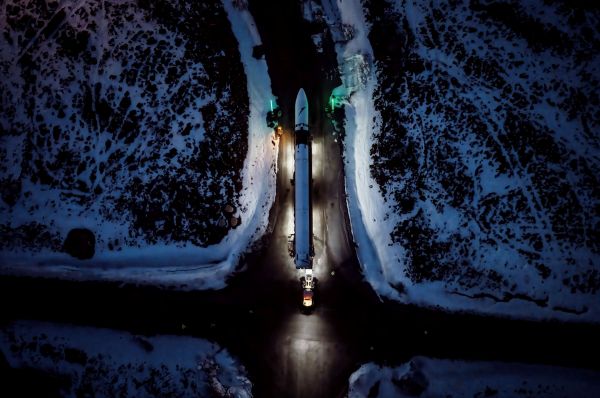
[DigitalToday AI Reporter] Isar Aerospace again halted the second test launch of its Spectrum rocket.
On June 15 (local time), IT outlet Ars Technica reported that the company stopped the countdown after confirming abnormal signs in the vehicle’s fluid system during launch preparations.
Isar Aerospace is analysing newly secured data to determine the cause. Spectrum was set to launch from the Andoya Spaceport in northern Norway, but a new launch date has not yet been disclosed. Andoya Space said the launch window is currently open through June 21.
The 28-metre, two-stage Spectrum rocket set four launch dates over the past five months for its second test flight, but all failed to lift off. It has missed three launch opportunities this year alone. On Jan. 21, a launch was cancelled due to a pressurisation valve issue. On March 25, the countdown was halted just before launch due to a rise in the temperature of the liquid propane fuel. Isar Aerospace explained that the countdown had been delayed when an unauthorised vessel entered waters restricted for the flight path, and the fallout led to the issue. On April 9, it postponed the launch to check a suspected leak in a composite overwrapped pressure vessel.
The operating environment at the Andoya Spaceport is also cited as a variable. The site is also frequently used as a military test range. Last month, a missile test was given priority, causing disruption in securing a launch schedule. Overlapping fishing activity in nearby waters with the launch hazard zone is also cited as a factor behind repeated scheduling conflicts.
Isar Aerospace is considered the most advanced runner among Europe’s next-generation rocket startups. Germany’s Rocket Factory Augsburg, France’s MaiaSpace and Spain’s PLD Space are developing small satellite launch vehicles, but Isar Aerospace is the only company to have carried out an actual test launch.
Still, the first test flight in March 2025 failed after the rocket crashed near the launchpad less than a minute after liftoff. The main cause at the time was identified as a loss of attitude control after a vent valve opened unintentionally.
The second test flight carried 5 CubeSats and 1 non-separable technology demonstrator. The launch is backed by the European Space Agency’s Boost! programme and the German Aerospace Center’s Microlauncher competition support project.
Isar Aerospace is set to receive up to 205 million euros through the European Space Agency’s European Launcher Challenge programme, and the scale of private investment and financing has exceeded 800 million euros. Adding a new 270 million-euro funding round announced last week, it has secured the strongest funding base among Europe’s private launch vehicle companies. Still, given repeated launch delays and limited flight experience, proving real operational capability remains a task.
 Seung-a Yoo
ysah@d-today.co.kr
Seung-a Yoo
ysah@d-today.co.kr