
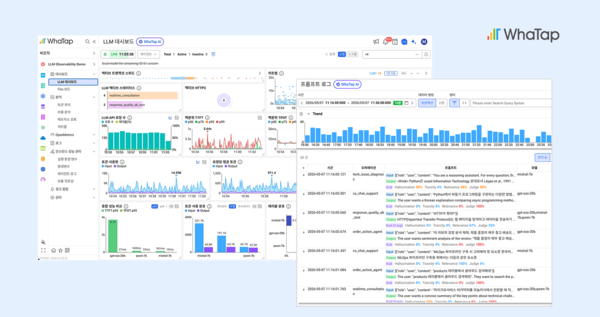
South Korean observability firm WhaTap Labs on Monday held an "LLM Observability Media Day" and announced an integrated strategy for AI "GPU, LLM and AI operations."
WhaTap Labs on the day unveiled a full-stack roadmap linking GPU monitoring, AI LLM observability and AI-based autonomous operations.
After declaring an "AI-native observability" vision last year and launching GPU monitoring, WhaTap Labs formally released LLM observability functions through the event.
Through its conversational AI, WhaTap AI, it is also advancing functions for automatic anomaly detection, root-cause inference and response actions. The company said that in AI environments, failures occur not from a "single cause" as in existing IT systems, but from complex causal relationships intertwined across all layers. For example, even service delays can have various causes, including a lack of inference GPUs, delays in LLM API responses, bottlenecks in the search stage and errors in application calls. That makes it essential to observe all layers at the same time.
With its integrated strategy for "GPU, LLM and AI operations," WhaTap Labs supports tracking the entire AI system as a single flow. That allows corporate IT operations teams to clearly conduct integrated analysis of AI systems in a single platform, which have so far been like a "black box" because they could not see inside.
Jin-sik Choi (최진식), head of development at WhaTap Labs, said the company is pursuing technological innovation that goes beyond fragmented monitoring by connecting AI resources, quality and autonomous operations into a single flow, to become customers' "eyes" for viewing complex AI layers at a glance. He added the company will further develop the technology into an AI-based autonomous operations stage in which AI first detects anomalies, infers causes and automatically takes action.
 Chi-gyu Hwang
delight@d-today.co.kr
Chi-gyu Hwang
delight@d-today.co.kr