
[San Francisco, U.S. = DigitalToday reporter Chi-gyu Hwang] Snowflake on Monday unveiled interoperability features that let companies use its own data as well as external data lakes and open-system data under a single governance model without moving or duplicating data, it said.
The announcement was made at the Snowflake Summit 26 annual conference being held in San Francisco.
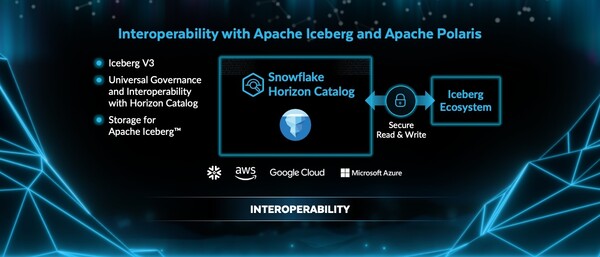
A key element is the general release of Apache Iceberg v3 and Snowflake support for Apache Iceberg tables.
This will support more data types, change tracking across systems and high-performance processing for semi-structured data.
Christian Kleinerman (크리스티안 클레이너만), Snowflake's executive vice president for product, said, "You can't keep up with the speed of AI by moving or duplicating data." He said, "The more innovation accelerates, the more data fragmentation becomes a major constraint. Snowflake supports applying a single, connected governance model wherever the data is, so you can work directly in real time."
Snowflake also highlighted Horizon Catalog based on Apache Polaris as part of its focus on interoperability.
Horizon Catalog, based on Polaris, an open-source data lake catalog, supports two-way read and write access to Iceberg data managed by Snowflake from external engines. It provides a single governance foundation spanning data inside and outside Snowflake.
Catalog Linked Databases support automatically discovering and accessing external Iceberg tables in Snowflake.
Customers can also use the Iceberg REST Scan Plan API to apply data protection policies such as column masking and row access control across Iceberg-compatible engines.
Integration with external systems was also strengthened. Beyond major platforms such as SAP, Salesforce and Workday, Snowflake also entered new partnerships with AVEVA and IBM and supports integration without data duplication through zero-copy integration.
Coco, Snowflake's coding agent, supports questions across Snowflake, external data lakes and external relational database systems. Horizon Context supports automatically identifying relevant data and applying a reliable business context. Snowflake said it expects this will enable higher-quality decision-making based on a governed data platform.
The Skill for SAP feature provided in Coco simplifies the process for developers to connect to, explore and manage SAP data in Snowflake.
Data-sharing methods are also changing. Open Data Sharing supports securely sharing data and AI assets with customers, partners and internal teams across all engines without copying data. Automatic Data Agents can also convert shared data into conversational AI agents that can be used immediately in Coco, CoWork and Snowsight.
Horizon-based connected audit access and new observability features for externally managed Iceberg tables support centrally tracking data access and pipeline status across Snowflake and external environments.
Herve Marcellini (에르베 마르첼리니), vice president of Samsung Ads Engineering, said, "Snowflake supports working across systems without data duplication while also maintaining consistent governance across environments." He added, "It can improve work speed, enhance targeting and measurement methods, and expand AI innovation based on trust." Yoshio Umezawa (우메자와 요시오), vice president of NTT Docomo, said, "We can now apply the same governance wherever the data is, maintaining a consistent and reliable foundation."
 Chi-gyu Hwang
delight@d-today.co.kr
Chi-gyu Hwang
delight@d-today.co.kr