
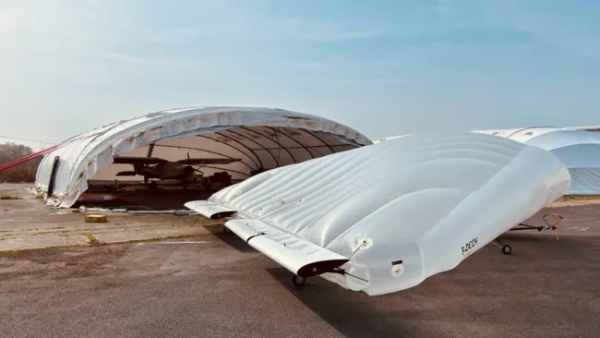
French aerospace startup Celeste Ecoplyers has completed initial flight tests of an experimental cargo drone fitted with air-inflated fabric wings. Instead of a metal-based rigid structure used in conventional aircraft, it uses an air-filled structure that maintains its shape.
On May 28, TechRadar reported that Celeste Ecoplyers carried out short takeoff tests of its cargo drone platform, the dAS10, at Le Havre airport in France.
The dAS10 replaces the aluminium spar-and-rib structure used in conventional cargo aircraft with an air-inflated fabric structure. The company said some had mistakenly assumed the unusual design relied on buoyancy like an airship, but it actually flies using aerodynamic lift like a conventional aircraft.
Celeste Ecoplyers said, "Lift comes from aerodynamics, not buoyancy," adding that air pressure is used only to maintain the wing structure.
The test consisted of a low-altitude flight lasting a few seconds, but confirmed the inflatable wing could generate the lift needed for controlled flight. The company said it also carried an experimental payload mass that exceeded the airframe's own weight, but did not disclose the exact loading ratio or any externally verified data.
The aspect drawing industry attention is the operating concept rather than performance. The company believes inflatable wings can be deflated, folded and compressed after use, sharply reducing the transport and deployment burden compared with rigid cargo aircraft. While conventional cargo aircraft require separate equipment and facilities for movement, maintenance and deployment, the inflatable structure could reduce reliance on on-site infrastructure, an assessment said.
Use in military logistics and disaster relief has been discussed. In situations that require carrying equipment and supplies to remote regions or harsh environments where conventional air support is difficult, the ability to fold for transport and rapidly deploy on site is cited as an advantage. The company also said field repairs could be handled with simpler tools and lower levels of specialist maintenance capability than composite airframes.
Radar response characteristics are also of interest. The company said a fabric-based structure could produce radar signals different from those of metal and composite aircraft, attracting interest in the defence sector. In combat environments, radar visibility of unmanned aircraft is assessed as a factor directly linked to survivability.
The dAS10, however, remains an early-stage prototype. Celeste Ecoplyers also acknowledged that additional tests are needed. Engineers said they are making further adjustments to weight balance and flight-control responsiveness.
Industry observers say the technology's success depends less on the unusual structure itself than on how well it can prove operating efficiency and durability in real environments. Whether inflatable wings can secure practicality and economic viability compared with existing cargo drones is expected to be decided by follow-up flight tests and long-term operating data.
 Jinju Hong (홍진주)
hongjj@d-today.co.kr
Jinju Hong (홍진주)
hongjj@d-today.co.kr