
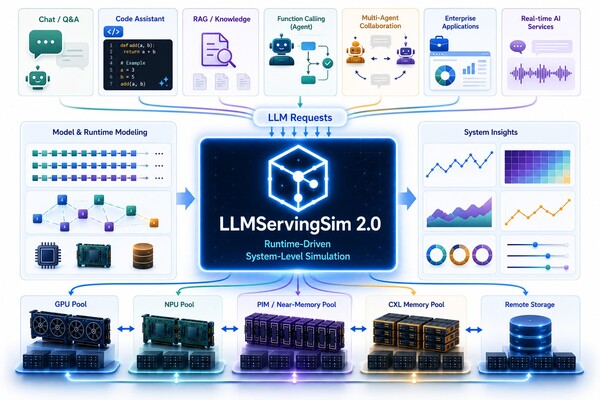
Researchers at KAIST developed a simulator that can verify performance and efficiency in advance before building large-scale artificial intelligence (AI) servers. It is a "virtual testbed" that can validate next-generation AI semiconductors and large language model (LLM) infrastructure without actually building costly server equipment.
KAIST said on Thursday that research on the LLM service infrastructure simulator "LLMServingSim 2.0," developed by a team led by Professor Jong-se Park of the School of Computing, won the best paper award at ISPASS 2026, a conference in computer system performance analysis.
LLMServingSim 2.0 is a simulation platform that can analyze various hardware and software combinations on a computer. Researchers and developers can test multiple design options and verify performance without directly building large-scale server infrastructure.
The technology supports a range of next-generation hardware environments, including neural processing units (NPUs), processing in memory (PIM) and CXL-based memory expansion devices, as well as existing graphics processing unit (GPU)-centered environments.
It can also test future AI semiconductors that have not yet been commercialized in a virtual data center environment. The team said it can analyze in advance service speed, power consumption and stability in large-scale server environments when applying a specific semiconductor.
LLMServingSim 2.0 reproduces, at the system level, request processing, batch configuration, memory use, data movement and power consumption that occur during real AI service operations. This makes it possible to analyze bottlenecks and efficiency problems caused by multiple interacting factors. It can also analyze distributed infrastructure environments that separate and connect multiple server resources, allowing it to be used for research into next-generation AI data centers.
The simulator is expected to be used by LLM service companies and AI semiconductor startups to design and optimize next-generation AI infrastructure. The team released LLMServingSim 2.0 as open source.
Professor Park said, "AI service competitiveness is determined not only by the model itself but also by infrastructure technology that operates it stably and efficiently." He added, "I hope this simulator will become an important foundation for researchers and industry to develop next-generation AI infrastructure faster and more efficiently."
The study was led by master's students Jae-hong Cho (조재홍) and Hyun-min Choi (최현민) of the School of Computing as co-first authors. It was carried out with support from the Ministry of Science and ICT, the Institute of Information and Communications Technology Planning and Evaluation, the Electronics and Telecommunications Research Institute and SK Hynix.
 Jin-ho Lee
jhlee26@d-today.co.kr
Jin-ho Lee
jhlee26@d-today.co.kr